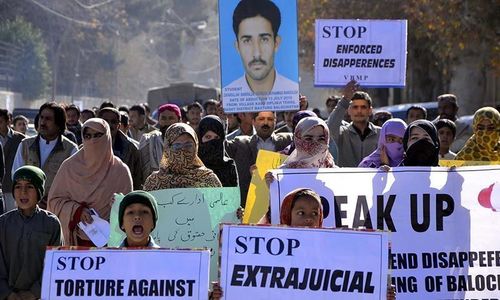
The chairman of the Missing Persons Commission, retired justice Javed Iqbal, said on Tuesday that the issue of missing persons "has always been politicised" and that the situation is "not as bad as it is made to sound".
While briefing the Senate Standing Committee on Human Rights, Iqbal briefed lawmakers that from at least 5,000 complaints received by the commission, the commission has dealt with around 3,800.
Saying that the matter of missing persons has "always been politicised", Justice Iqbal said that Mama Qadeer — Leader of the Voice for Baloch Missing Persons (VBMP) — had claimed that 40,000 people are missing, "and yet, to this day, we do not have any details regarding those cases".
The retired judge also claimed that no government in the past 15 years made an effort for the recovery of missing persons.
"In Balochistan, there are merely 131 cases regarding missing persons being heard," Justice Iqbal said, adding that, in a number of instances, the commission had found that people are picked up by rival tribes due to personal enmity.
He also mentioned that after an inquiry was made, at least eight people who were said to be missing from Balochistan were found to be "happily running their businesses in Parachinar".
He added: "When Bramdagh Bughti, Herbyar Marri and Khairbux Marri left the country, they took hundreds of men with them. To date we haven't even been able to find out how many of our people are jailed in neighbouring countries."
Justice Iqbal claimed that there are also a number of people from Balochistan and Khyber Pakhtunkhawa who are jailed in Paktia and Nangarhar in Afghanistan.
"When a country has the beggar's bowl in one hand, its neighbours tend to interfere in internal matters. We can't even ask them how many of our people are jailed there. When we asked, we found out that even the Afghan government has no control over these prisons."
Moving on to Sindh, the head of the commission said that out of 1,357 cases received from the province, the commission had taken care of 1,174 and 183 remain open.
"A majority of the cases in Sindh involve workers of the Muttahida Qaumi Movement (MQM)," Justice Iqbal told lawmakers, informing them that Justice Ghous Muhammad was overseeing cases pertaining to Sindh.
Criticising the parliament's lack of initiative in the matter, Justice Iqbal said: "The job of parliamentarians is not to tie black bands around their arms; it is to bring legislation to safeguard the rights of citizens. They have still not made any laws [to facilitate recovery of missing persons]."
Upon this, Senator Usman Kakar took a line from Iqbal's defence and retorted saying that the relevant information regarding the matter never reached the members of the assembly.