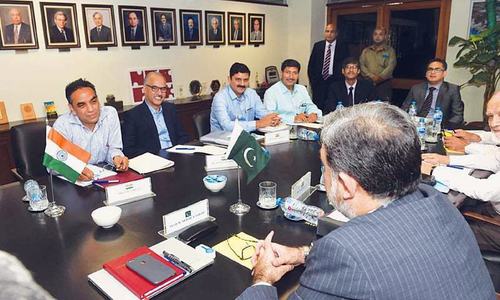
After many years, a small but significant breakthrough seems to have been made in the talks between the Pakistani and Indian water commissioners.
The talks had been largely stalled since 2014 so the latest agreement by the Indian side to permit an inspection of two of the facilities being built on the Chenab river is a step forward. Even in the latest round of the Permanent Indus Commission talks, the first day seemed to lead to a cul-de-sac. It was only at the end of the second day that news of the breakthrough emerged.
It would have been better for both sides had they jointly briefed the media, or if that were not possible, issued a joint press release. Ending the talks without any public word is counterproductive as it creates an impression that runs contrary to the positive news emerging of an agreement for inspections. Now that it seems a deal has been struck for inspection, the next step is for Pakistan to make the most of the opportunity.
At issue are two hydropower projects that India is building on its side of the Chenab river whose waters belong to Pakistan under the Indus Waters Treaty. The same treaty, however, gives India the right to build hydroelectric projects on the river provided that it does not divert water for agricultural purposes. One other project on the same river, the so-called Baglihar dam, had already been the subject of a bitter feud between the two countries around a decade ago when the matter was sent to a neutral expert for settlement. The results of that exercise were mixed, with both sides claiming victory once the neutral expert’s verdict came in.
The two projects this time round are the Pakal Dul dam and the Lower Kalnai hydroelectric project. The former is a large project totalling some 1,000MW, while the latter is smaller at about 48MW. But both of them involve the diversion of waters from tributaries that feed the Chenab, much like their cousin built on the Neelum river, the Kishenganga Dam.
This is a different design configuration that involves the diversion of water from one tributary to another to take advantage of the water head, but the same water is returned to the river at a different spot further downstream. As such, its technical evaluation becomes more difficult, and the Indian side should honour its agreement in full by allowing the Pakistani delegation to visit the entire area where the project is spread out.
Both sides should make an effort to ensure that resorting to arbitration is avoided. Almost every Indian project on the Chenab and Neelum is landing up at the altar of the World Bank, portending an unhealthy trend with regard to both countries that appear unable to resolve their mutual differences.
Published in Dawn, September 1st, 2018