'Pakistan must move towards multi-family housing to accommodate its high population density'


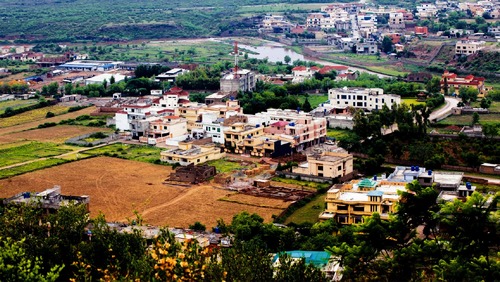
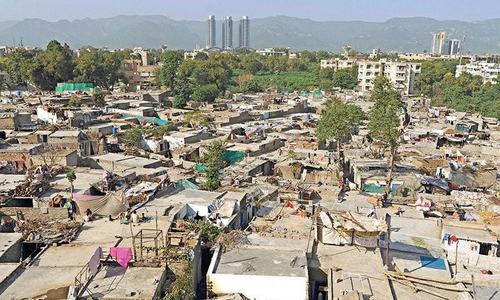
Although individual family units have become the popular choice for residence among Pakistanis in recent years, the solution to accommodate the country's burgeoning urban population lies in multi-family housing.
This was stated by Dr Spiro Pollalis, Professor of design, technology and management at the Harvard Design School who was conversing with architect Mukhtar Husain on Tuesday at an event titled 'Doxiadis in Pakistan — The genesis of Islamabad and the Karachi Master Plan'. The event was held to discuss the legacy of Greek architect Constantinos Apostolou Doxiadis, who is best known in Pakistan for being the lead architect of Islamabad city.
Prof Pollalis, who is also the chief planner of the DHA City Karachi housing project, said he had observed a growing trend among Pakistanis to want to live in single-family houses, but this kind of a model is not sustainable from an urban planning perspective.
"Not only is there no land [to build so many individual houses], but if we build like this, it generates a lot of traffic and mass transportation is not effective," he told the audience at Karachi's Mohatta Palace Museum. He added that in order for mass transportation to work, a country needs to have compact cities, and cited the example of New York City in this regard.
According to the expert, it is important for urban planners to keep proximity in mind when planning cities. "We need to be near our work and our schools," he stressed.
The scholar informed the audience that Doxiadis had based his city development philosophy on five elements – shells (all buildings and structures), nature, human beings, society (people’s interaction with trends, group attitude and social customs) and network.
He said Doxiadis's Ekistics design and science comprised principles extracted from economics, sociology, technical disciplines, political science and administration, and cultural disciplines and the architect saw cities as living organisms.
'City of the future'
While discussing the Islamabad master plan, Prof Pollalis said Doxiadis had envisioned Islamabad as a "city of the future".
Also read: How Islamabad's posh Bani Gala neighbourhood is built on illegalities
He acknowledged that various sectors of the capital had not been developed properly as envisaged by Doxiadis, and Husain pointed out that the population density of many of Islamabad's sectors is three times that was originally intended.
Prof Pollalis remarked that the problem was not the high population density itself, which he said was now desirable to accommodate the large urban populations, but that the original Islamabad master plan was drafted for a low density of people.
In order to shift from low-density infrastructure to that meant for a high density, "it is not enough to just build in between", the urban planning expert said. He added that the capital administration needed to adapt to the modern needs of the city while maintaining the spirit of the original design.
But despite the flaws, Pollalis maintained, the Islamabad master plan was implemented quite well by the capital authorities and its sectors-based design is "excellent" from a security point-of-view.
"Islamabad is by far the best example of the implementation of what [Doxiadis] designed," he said.
Why the Karachi resettlement plan failed
Also part of the discussion was the conceptualisation and subsequent failure of the Greater Karachi Resettlement Plan, under which Doxiadis proposed that low-income groups would be re-settled in two large satellite towns in Korangi and New Karachi, with industrial and commerical centres that would provide employment to residents.
Asked why the plan had failed to take off, Prof Pollalis said the answer was simple: "It was not implemented well."
Husain explained that as per the plan, the people were moved to the satellite towns but the industries and professionals did not move there. Also, because of a lack of workplaces in their vicinity, the residents also faced a commuting problem.
Doxiadis had written that he was "disappointed" to see during his early visits to the area that things were not implemented as he had envisioned. The infrastructure was not being built, the community centres were not developed and illegal shops started occupying public spaces, Pollalis said.
Summarising his point, the scholar said those in charge of implementing the Greater Karachi Resettlement Plan did not take into account the economic and sociological factors that would ensure the plan's success.