Accord in National Assembly to finally get on with budget debate


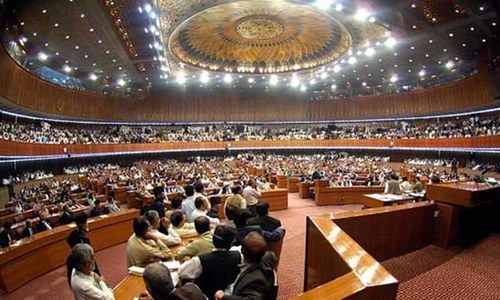
ISLAMABAD: After wasting one whole week, the government on Tuesday finally agreed with the opposition not to disrupt a debate on the federal budget in the National Assembly following the reconciliatory efforts of Deputy Speaker Qasim Suri that brought both sides to the negotiating table.
During over hour-long negotiations between the government and the opposition representatives, the two sides agreed that they would listen to the speeches of each other with patience and without creating disturbances. They also reached an understanding that a treasury member would be given the opportunity to speak after every speech of an opposition member.
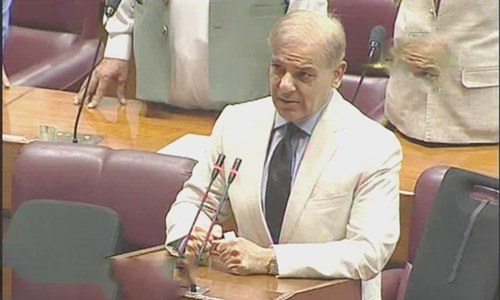
Under the agreement, Opposition Leader Shahbaz Sharif will now open up the general discussion on the budget on Wednesday morning (today). The budget had been presented by the government in the NA on June 11.
The deputy speaker facilitated the talks after failing to maintain order in the house, as the treasury members once again created a ruckus as soon as the opposition leader began his speech. Mr Sharif, who had been trying to speak for the past three days, continued his speech amid noisy protests by the treasury members, including federal ministers, who as usual ignored the constant warnings by the chair to maintain discipline.
PPP members stage sit-in outside Speaker’s office for a second consecutive day
Mr Suri told the members that copies of Rule 20 of the Rules of Procedure and Conduct of Business had been provided to each of them and they should avoid its violations, as the rule provided that the speaker could “direct any member whose conduct is, in his opinion, grossly disorderly to withdraw immediately from the Assembly”.
Asking senior leaders from both sides to sit on a table to sort out the issues, the deputy speaker announced suspension of the proceedings for 20 minutes though the suspension period lasted more than an hour.
“The senior leaders from both sides have agreed that the house will be run in a democratic way. Everyone will be free to present his viewpoint,” Mr Suri announced when the house resumed after the talks between the government and the opposition.
The lawmakers from both treasury and opposition sides lauded the deputy speaker’s reconciliatory efforts, but once again accused each other of spoiling the environment.
Read: NA session adjourned as chaos prevents budget debate from progressing
Former prime minister Raja Pervez Ashraf of the Pakistan Peoples Party (PPP) and firebrand member of the Pakistan Muslim League-Nawaz (PML-N) from Sialkot Khawaja Asif were of the opinion that smooth running of the assembly proceedings was the main responsibility of the treasury benches.
Speaker slammed over production order issue
While criticising Speaker Asad Qaiser for not issuing production orders of the four arrested lawmakers, specifically of former president Asif Zardari, Mr Ashraf said the speaker should play the role of an “independent custodian” of the house instead of getting dictation from the government.
Read: Opposition team asks NA speaker to issue Zardari’s production order
Drawing the speaker’s attention to Prime Minister Imran Khan reported statement that he would not issue the production order of Mr Zardari, Mr Ashraf termed it an “effort to undermine the speaker’s office”.
The PPP lawmaker reminded the chair that under the rules the speaker was bound to ensure presence of each and every member during the vote on any matter, including the budget.
PML-N legislator Khawaja Asif said he had seen two previous speakers serving during the military rule of retired Gen Pervez Musharraf, but “the speaker’s institution was never as weak as it is today”. He recalled that the speaker had issued the production order of present railways minister Shaikh Rashid Ahmed even before insertion of this rule. Similarly, he said, Javed Hashmi kept on attending the proceedings through production orders by the speaker under the Musharraf regime.
Mr Asif alleged that through their protests during the speech of Mr Sharif, the treasury members were blackmailing the opposition and wanted an assurance that the opposition would not create any disturbance when the prime minister would come to the house.
He warned that whenever the parliament was made non-functional in the past, democracy was wrapped up in the country. He also termed the PM’s reported statement about Mr Zardari’s production order an “insult” to the parliament, alleging that the speaker had completely “surrendered” his powers.
Federal Minister for Science and Technology Fawad Chaudhry asked the speaker to ensure that the opposition members would not stage a walkout from the house when the ministers would respond to their speeches. He alleged the opposition members were not interested in resolving the national issues as they did not take any interest in the parliamentary committee that had been set up on the opposition’s demand to investigate the allegation of rigging in the last year general elections.
Minister of State for Parliamentary Affairs Ali Mohammad Khan criticised the opposition for creating disturbance in the house during the inaugural speech of the prime minister after his election and then each time when the latter tried to speak. He asked the opposition to respect the “office” of the prime minister. He said they had previously allowed Mr Sharif and PPP chairman Bilawal Bhutto-Zardari to deliver lengthy speeches, but “there must be a limit”.
Earlier, the PPP members staged a protest sit-in outside the speaker’s office for a second consecutive day, demanding issuance of production order of Mr Zardari. Some members were also seen sitting at the door connecting the speaker’s office to the main assembly hall to prevent the speaker from entering the house. The PPP’s protest delayed the assembly proceedings for more than an hour.
At the outset of the sitting, Adviser to the Prime Minister on Finance Abdul Hafeez Shaikh laid Assets Declaration Ordinance 2019 before the house.
Published in Dawn, June 19th, 2019