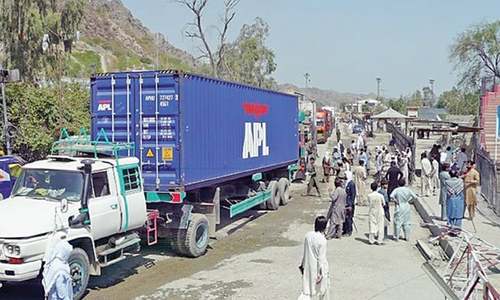
Afghan transit trade pact being amended to curb smuggling


ISLAMABAD: The government is working on various proposals to introduce amendments in the Afghanistan-Pakistan Transit Trade Agreement (APTTA) to control the pilferages in movement of goods to Afghanistan, Dawn has learnt.
The amendments are proposed at various forums following complaints of rising smuggling of goods in the country which is harming local production. The issue gained importance following the diversion of transit trade to Pakistan in the wake of US sanctions on Iran.
An official source in the commerce ministry told Dawn that the proposals evolve around three areas: enhance the number of goods in negative list, allow quota for certain products or collect duty on Pakistani ports and refund on transit out.
Under the existing agreement, there are only two items in the negative list — cigarettes and auto parts. “We have proposed several items to be included in that list,” the source said. The items placed under the negative list will not be allowed for import under the agreement.
According to the old Afghanistan transit trade agreement; there was allocation of quota for import of smuggling-prone items under the treaty. With the implementation of the revised pact, Pakistani government has done away with this condition.
A senior official in the Federal Board of Revenue told Dawn that the country needs to allow quota-based import of smuggling-prone items, which is under the transit agreement. According to him, globally all the three ways — negative list, duty paid and refund on transit out and quota-based import — are used. “We have liberalised our agreement to the extent of damaging our industry,” he said.
Another source in the transit directorate said that goods under transit crossed border under electronic surveillance. He said the track and trace system is already in place to check the pilferage of transit goods in the country.
“We have 100 per cent reconciliation of transit goods on a real-time basis between the two customs — Pakistan and Afghanistan,” the official claimed. He said that goods might get back into the country through the porous borders.
In 2018-19, the import value of transit goods reached to over Rs5bn, from Rs3bn in the previous year, showing an increase of 66.6pc. This jump in the worth of transit cargo can be attributed to the recent sanctions on Iran, the official said.
Afghan importers have diverted their transit imports mostly to Bandar Abbas port in the wake of some restrictions introduced in the revised transit trade agreement. “We have seen the rising trend of cargo under transit on the Pakistani ports,” he said.
The government has already established dedicated customs transit directorates to facilitate and control the pilferages of goods under the agreement. Last month, the two countries resumed talks to iron out differences in the way of transit treaty after a three-year hiatus. Another follow up meeting is scheduled for August 6 in Islamabad.
Talks between the two neighbours had collapsed in September 2015 after Kabul insisted on including India in transit treaty negotiations and the trilateral trade agreement involving Pakistan, Afghanistan and Tajikistan.
The turnaround came after Afghan President Ashraf Ghani met with Prime Minister Imran Khan in Islamabad on June 27 where both sides agreed to deepen trade relations.
Pakistan’s exports to Afghanistan peaked at $2.4 billion in 2010-11 and remained north of $2bn mark in 2011-12 and 2012-13 before eventually falling to $1.3bn in 2018-19 after talks between the two sides broke down.
Published in Dawn, August 4th, 2019