Programme off to a good start: IMF


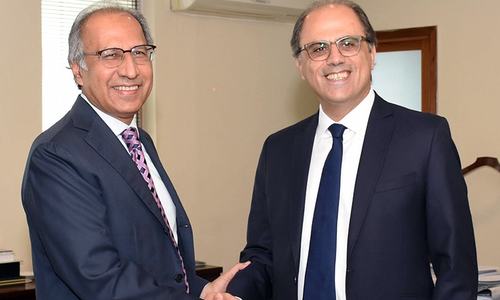
KARACHI: The International Monetary Fund’s (IMF) Director Middle East and Central Asia Department Jihad Azour on Thursday suggested the government to increase length of the State Bank of Pakistan governor’s tenure from the existing three years.
In a long and detailed interaction with media, the director said that in order for it to be in line with international practices, the SBP governor’s term of service should be closer to five years.
He said this while elaborating on a question about the specifics of the reforms the IMF was seeking for the central bank.
Read: IMF programme off to good start, cannot be revised after only 3 months: Jihad Azour
Other reform measures included “greater operational autonomy in law” as well as changes in the priority of the objectives set for the central bank, as well as an end to all State Bank credit to the government.
He said his visit to Pakistan “is not a review since that is scheduled for end of October or first week of November.” Instead, the purpose of his visit is only to “meet the authorities and key stakeholders to get a first hand impression of how the situation is,” he emphasised.
Recommends five-year tenure for the position of State Bank governor
His words put to rest the controversy that his visit was in response to slippages in programme implementation thus far or an SOS from the government.
“Nobody in government asked for any changes in the targets” or timelines contained in the programme, he said in the interaction at a local hotel in Karachi, where Azour is visiting after his discussions in Islamabad.
He was accompanied by Mission Chief for Pakistan Ernesto Ramirez Rigo and Teresa Daban Sanchez, the resident representative in the country.
“It is far too soon in the programme to expect anything, the first review will be the time to see if we are on track with the targets,” he said, though he was able to say that “the programme is off to a good start”, without getting more specific regarding the numbers. “Early signs show things are responding faster than they do in other countries”.
When asked on the risks faced by the programme, he replied that there are several pillars upon which the envisaged package of stabilisation and reforms stands, and “each of these pillars need to be moving together, not just stabilisation.”
Second, he pointed to external shocks, for which he said the country needs to “build buffers”, referring to fiscal space and foreign exchange reserves.
“Reform fatigue could begin to set in,” he continued, saying “people might feel too much pain, but wait and see mode will not help the economy.”
When asked whether he sees the present state of play of politics in the country as another potential area of risk, he deferred answering, saying simply “I am not knowledgeable enough of the complexity of Pakistani politics” and put the question to Ernesto Ramirez Rigo, the mission chief for Pakistan.
“Politics will present a challenge,” Rigo said, adding that the programme “will require building consensus.”
“In some areas like regulatory reform or SBP reform consensus should be easy to get,” he continued, “but other areas will require building consensus.” He would not get more specific.
He said it is important to make the reforms irreversible, giving the circular debt as an example. “It is important not just to address the stock and flow of the circular debt at this time, but to ensure it does not reemerge in the future.”
He also emphasised “scaling up social protection and public capital spending” with the resources that will accrue to the state down the road with successful programme implementation.
“Commitments have been made from both sides,” he said towards the end, referring to the programme’s conditions.
“And these commitments need to be maintained.”
IMF team meets SBP governor
In a separate development, the IMF delegation led by Director Middle East and Central Asia Department Jihad Azour also met with SBP Governor Reza Baqir to discuss the country’s economic situation.
The SBP governor while sharing his views on the economy with the visiting delegation said that, “Pakistan has embarked on its home-grown economic reform programme and said that he looked forward to a continuing fruitful partnership with the IMF and other stakeholders in the international financial community to support this reform programme.”
He also added that the initial results from the reform IMF programme were “encouraging”.
Published in Dawn, September 20th, 2019