Afghanistan election results ‘delayed’


KABUL: Preliminary results expected on Saturday after last month’s presidential election in Afghanistan have been delayed, the election commission said.
Officials had previously indicated that results would likely be pushed back. But in her announcement, Awa Alam Nuristani, who heads the Independent Election Commission (IEC), did not say how long the vote count will be delayed.
“Unfortunately, because of some technical issues and for transparency, we could not announce the results based on the election timetable,” she said, apologising at a press conference.
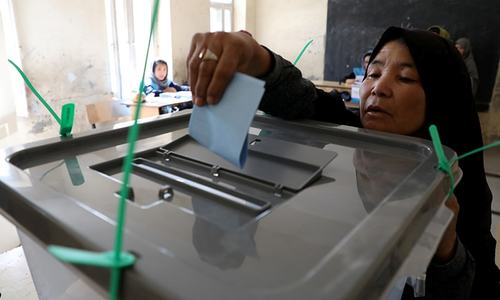
The IEC previously said that less than one-third, or about 2.7 million of Afghanistan’s 9.6 million registered voters, cast ballots in the Sept 28 first-round poll.
With fears of fraud and threats of deadly Taliban violence, it was a record low turnout.
The contest featured 18 candidates but President Ashraf Ghani, seeking a second five-year term, and Afghanistan’s Chief Executive Abdullah Abdullah, are the favourites.
Just two days after the election and before all votes had even arrived in Kabul for counting, Abdullah claimed victory in a move that international and local observers panned as premature.
On Oct 12, his running mate Asadullah Saadati complained of “systemic fraud” organised by “circles within the election commission and the palace”.
Voting this year was supposed to be more secure than ever, with each voter verified through biometric machines to ensure no one could cast multiple ballots.
Saadati claimed the IEC was counting “fraudulent” and non-biometric votes.
The IEC has repeatedly said it would not count votes unless they had been verified biometrically.
But use of biometric readers to prevent repeat voting complicated the process, partly because communication breakdowns prevented data from numerous readers being transmitted to the IEC on voting day. Instead, the machines had to be taken to the commission in Kabul to extract the data.
Highlighting the challenges it faces, the commission has said unidentified hackers unsuccessfully attempted to break into its computer servers.
Published in Dawn, October 20th, 2019