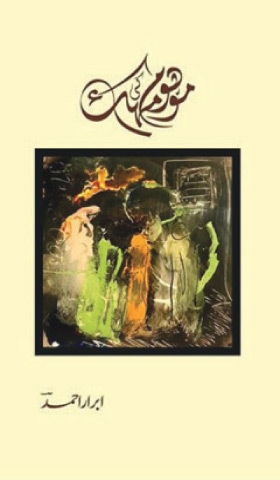
A strange and fascinating spirit seems to emanate from the poems in Abrar Ahmad’s newest collection titled Mauhoom Ki Mahak [A Fragrance from the Imaginary/ Vague]. These are far from the run-of-the-mill stuff far too many readers know in the name of poetry. There is longing, a deep desire to connect with the imaginary, and the poem after which the book is titled seems to particularly embody this spirit; it is a poem of love and longing, but the love to be found here is a far cry from the prevalent romantic kitsch. The longing is all the more poignant as it is not articulated in clear terms. The beauty of the poetry lies in its suggestive manner as it moves across shades of feeling.
Ahmad is a renowned poet with a distinguished career behind him. He is equally at home in the genres of ghazal and nazm and, to his credit, has published collections of both, which have been well received by readers as well as critics. Although the poet has expressed himself in the ghazal form previously, this book consists of nazms only, so there is a unity of themes and moods.
Over the years, Ahmad has developed a style that sets him apart from other poets and makes his poems unique. He constructs his poems by putting things in surprising juxtaposition, and each of these leads to sadness tinged with a sense of inexplicable loss, a feeling of disconnectedness, which aggravates and intensifies the sense of loss, but still with a mildness of manner that never makes the poetry loud or complaining.
There is a remarkable consistency in the style in the entire volume. The poet has maintained his style so that hardly any poem goes below the average. Some stand out, though, and are worth looking at in more detail. The poem after which the collection is named draws its images from an all-pervasive mist in which hands are not visible and the eye cannot discern the path ahead. A nameless love is lost in this situation and the poem ends on a note of hankering for this great unknown.
Then there are some poems that have a direct context, as a reference is provided. One poem is addressed to Sylvia Plath and another describes the poet’s complex emotional response on reading Mir Taqi Mir. The Plath poem reminds me of John Keats’s beautiful sonnet written after encountering George Chapman’s version of Homer.
Written in a clear style and modern idiom, these poems display concerns of one of the most important contemporary poets writing today
Moving away from direct expressions, Ahmad equates this reading with suddenly becoming drowsy while driving, colliding with trees, going against the clockwise movement of time, roads and towns becoming inundated with sounds which cannot be heard, and evocative lines which show the inaccessible and the unattainable coming within a man’s reach only through the medium of poetry. It is a modern poet’s tribute to a great classical poet and, characteristically, it is steeped in a modern idiom. Yet another poem is addressed to Don Quixote, who appears symbolic of the many concerns of the poet, such as identity and the futility of life.
One of the most remarkable poems here is simply called Sairbeen [Kaleidoscope] and predictably includes a long chant of sights and objects to be seen through a kaleidoscope, especially of the kind that is a common sight at public entertainments and fairs known as tamaashas and melas. Yet, from a seemingly plebeian style, the poem takes off into an unknown zone, which is an invitation to see as much as possible with eyes lost in sleep — or in tears, as the poet points out.
In an extension of this abstract style, one poem is addressed to some Khan Sahib; this could be taken as a political comment. Another poem questions a persistent rider without making his identity clear: ‘why don’t you get off from the donkey?’ A few poems are tinged with irony which can be directed by the poet against himself or the troublesome conditions of existence. Wasted and lost time is the starting theme of another haunting poem.
Written in a clear style and modern idiom, Mauhoom Ki Mahak displays the themes and concerns of one of the most important contemporary poets writing today. Aware of his power and keeping himself within his limits, this collection displays one of the best poets of the day writing at the height of his powers. It is a treat to read Ahmad’s new collection.
The reviewer is a fiction writer and critic. He teaches literature and humanities at Habib University, Karachi
Mauhoom Ki Mahak
By Abrar Ahmad
Saanjh, Lahore
ISBN: 978-9695932971
248pp.
Published in Dawn, Books & Authors, February 16th, 2020