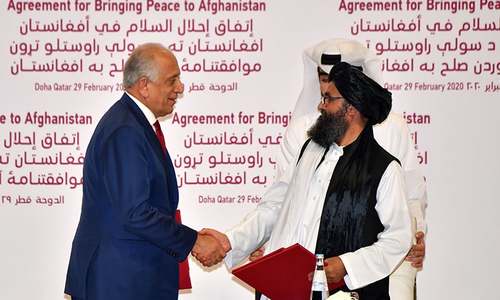
THERE are a variety of opinions regarding the chances of success that the peace deal recently signed between the US and the Afghan Taliban in Doha has.
Pessimists see the deal as a ruse by the hard-line militia to get the Americans out of Afghanistan in order to consolidate their grip on the country by overpowering the fragile dispensation in Kabul.
More optimistic voices, however, view this as a historic opportunity to end decades of bloodshed in this battered country.
What is clear is that such a complicated and long-running conflict is unlikely to wind down in days or weeks, and success will be incremental, even if all parties play by the rules.
The peace deal also highlights the fact that over the years, successive US administrations have completely misread the Taliban and were unable to understand the complexities of Afghan society.
At one time, Washington portrayed the Afghan Taliban as the embodiment of evil; today, America’s high officials are treating the militia as legitimate stakeholders in the Afghan political process. Perhaps if this realisation had dawned on the US earlier, the violence could have ended many years ago.
The Taliban emerged from their stronghold in Kandahar in the mid-1990s and essentially filled the power vacuum that a chaotic Mujahideen/warlord dispensation had created.
While, indeed, they employed brutal methods to cement their rule, ideologically, as pointed out in these columns, the Taliban were Islamist nationalists, as opposed to the pan-Islamic militant outfits such as Al Qaeda, or the many groups active in South and Central Asia, which wanted to recreate a caliphate.
One of the reasons the Taliban forged an alliance with Al Qaeda was because they were shunned by the international community, despite ruling Kabul. Osama bin Laden’s outfit provided them with much-needed funds, and perhaps if global powers had engaged with the Taliban, history might have taken a different trajectory.
The Taliban themselves have evolved over the years; while at one time they shunned all vestiges of modernism and enforced a mediaeval code, today, the tech-savvy insurgents are on Twitter and their leadership happily poses for the cameras.
The Americans tried and failed miserably to remake Afghanistan in their own image.
Afghanistan is by nature a culturally conservative society and most Afghans adopt the symbols the West holds up of ‘extremism’ — the burqa, the beard, religious orthodoxy — voluntarily.
Hoping that this society would be transformed into a liberal democracy within a few years was incredibly naive and reminiscent of the colonial ‘civilising missions’ of yore. Moreover, another destructive byproduct of sidelining the Taliban has been the emergence of even more fanatical groups, such as the local IS chapter.
Time will tell if these lessons are integrated into a more realistic Afghan policy by the US and its allies, or if the follies of the past will be repeated.
Published in Dawn, March 3rd, 2020