Here's how the Sindh govt is planning to reach the most vulnerable with rations
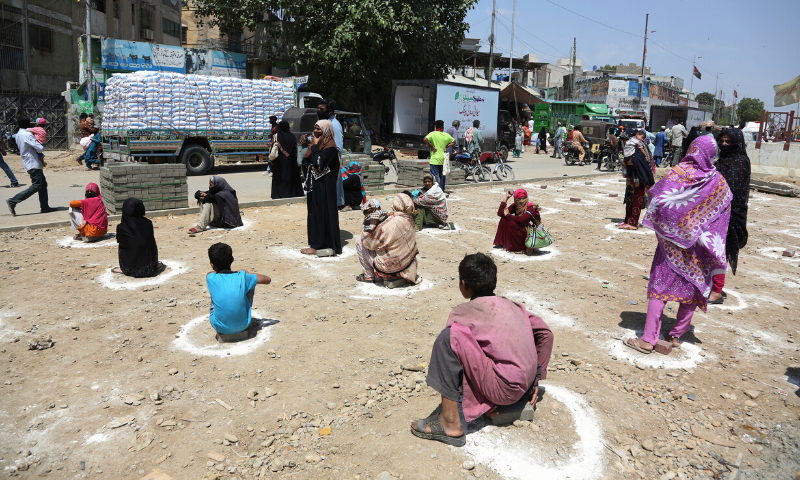

After Sindh became the first province to announce a lockdown on March 22, closing non-essential shops and businesses and restricting movement, concerns arose about survival of daily wagers and others living below the poverty line.
The provincial government announced it would distribute rations among deserving people and Chief Minister Murad Ali Shah formed a five-member committee for relief work, which included ministers Saeed Ghani, Imtiaz Sheikh and Nasir Hussain Shah, government spokesman Murtaza Wahab and CM's Coordinator Haris Gazdar.
The provincial government also launched a mobile application, Sindh Relief Initiative, for people and non-governmental organisations (NGOs) to register themselves so the relief and distribution work could be streamlined.
While the Sindh government has been commended by some for its early efforts to control the spread of the coronavirus, it appears ration distribution has been off to a slow start. Almost two weeks into the lockdown, the government was still working on chalking out a mechanism for distribution although its ministers said it was being finalised and ration distribution had already started.
Sindh government spokesperson Murtaza Wahab, while talking to Dawn.com, said the provincial government had taken the first step and already distributed Rs600 million to some 95,000 families.
"When we decided to impose the lockdown, we also decided that we would provide relief to people so they would stay in their homes. We already had a list of families registered with the Zakat department so we decided to give Rs6,000 per family to provide immediate relief."
The second phase was cash disbursement on a larger scale, he said, for which the government needed to ascertain who was "deserving". For this, they reached out to four federal institutions — National Database and Registration Authority (Nadra), State Bank of Pakistan (SBP), Federal Board of Revenue (FBR) and Pakistan Telecommunication Authority (PTA).
Explaining how the government would determine which people were deserving, Wahab said those who registered to receive rations would be verified through Nadra (only one member of each family would be eligible for relief), SBP (only people with less than Rs10,000), FBR (to ensure that the person was not in their taxpayer data) and PTA (to check which tower areas the person had messaged from).
Provincial minister Imtiaz Sheikh, while explaining the process further said that there were two separate programmes the government had decided on — ration distribution and cash disbursement.
He added that another way to determine deserving individuals would be through committees formed under District Commissioners (DCs). These committees also included members from the union councils, chairman of the Zakat department and people associated with NGOs.
"A list has been made, people have been identified and distribution work has started. The list includes those registered with the Zakat department, and has been compiled with the help of union council members, NGOs and people who come themselves to the government," he clarified.
Partnering with federal govt
Wahab added that Sindh had requested the federal government to cooperate in the disbursement programme, which would increase outreach and ensure uniformity in the process. The federal government's process for payment of Rs144 billion under the Ehsaas Emergency Cash Programme is set to start from Wednesday (tomorrow).
Overall the federal government will provide Rs12,000 assistance each to 12 million families across the country, while the provincial government has decided to contribute funding for the assistance of additional 250,000 people.
"In the next phase, the federal and Sindh government will together disburse money to some 3.5 million families. Some of the amount will come from the federal government while the Sindh government will cover the deficit amount."
'Centre not fully cooperating'
Wahab said federal institutions, especially Nadra, had been largely cooperative but alleged that the SBP and PTA had not been "very willing".
Read: Red zone files: Who has sinned?
Sindh Information Minister Syed Nasir Hussain Shah had made similar comments in a show on Geo News, saying that the government was facing some "technical issues" such as getting data and approval for the telephone number the Sindh government would use to register people.
Senator Sherry Rehman in a post on Twitter also criticised the federal government for its "slow response" to requests by the Sindh government for information.
Acknowledging difficulties in ration distribution, Shah said: "We have to find a way to avoid crowds as that would defeat the very purpose of the lockdown. We want to find a way to deliver this facility to their doorsteps. We have been working on it for the last 10-12 days."
Wahab said that the "impression" that ration distribution had not yet begun was wrong as PPP MNAs, MPAs and Senators had already started to facilitate distribution in their constituencies without government funding and recently the Sindh government announced ration worth Rs25m had been provided to the district administration for distribution.
However, that has not come without its due share of criticism as people in several parts of the province protested against what they termed "favouritism" in ration distribution.
Wahab added that the chief minister had held a meeting with philanthropists and asked them to ensure the rations were delivered to people's homes.
"We are standing with the people of Sindh during this time," Sheikh said.
Protests in Karachi over ration distribution
Meanwhile, daily wagers have grown anxious as the lockdown goes on and only limited rations are available. On Thursday, some 500-600 people protested and pelted stones on vehicles moving on Mauripur Road. The protesters were demanding ration and opening of fisheries which they said was their only means of livelihood.
Read: Amid scarce handouts, anxiety grows among wage earners due to lockdown
On Wednesday, several thousand people stormed the National Highway near Quaidabad to get rations which turned into a protest as the welfare organisation distributing them ran out.