US President Trump won’t commit to peaceful transfer of power if he loses


United States President Donald Trump again declined to commit to a peaceful transfer of power if he loses the November 3 presidential election.
“We’re going to have to see what happens,” Trump said on Wednesday at a news conference, responding to a question about whether he’d commit to a peaceful transfer of power. “You know that I’ve been complaining very strongly about the ballots, and the ballots are a disaster.”
It is highly unusual that a sitting president would express less than complete confidence in the American democracy’s electoral process. But he also declined four years ago to commit to honouring the election results if his Democratic opponent, Hillary Clinton, won.
His current Democratic challenger, Joe Biden, was asked about Trump’s comment after landing in Wilmington, Delaware, on Wednesday night.
“What country are we in?” Biden asked incredulously, adding: “I’m being facetious. Look, he says the most irrational things. I don’t know what to say about it. But it doesn’t surprise me.”
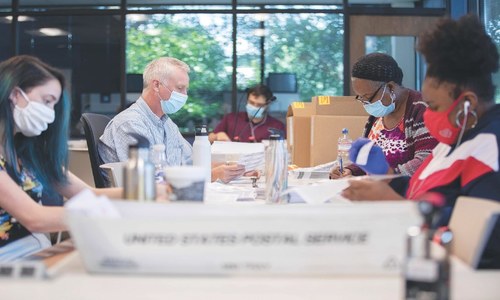
Trump has been pressing a month-long campaign against mail-in voting this November by tweeting and speaking out critically about the practice. More states are encouraging mail-in voting to keep voters safe amid the coronavirus pandemic.
The president, who uses mail-in voting himself, has tried to distinguish between states that automatically send mail ballots to all registered voters and those, like Florida, that send them only to voters who request a mail ballot.
Trump has baselessly claimed widespread mail voting will lead to massive fraud. The five states that routinely send mail ballots to all voters have seen no significant fraud.
Trump on Wednesday appeared to suggest that if states got “rid of” the unsolicited mailing of ballots there would be no concern about fraud or peaceful transfers of power.
“You’ll have a very peaceful — there won’t be a transfer frankly,” Trump said. “There’ll be a continuation. The ballots are out of control, you know it, and you know, who knows it better than anybody else? The Democrats know it better than anybody else.”
In a July interview, Trump similarly refused to commit to accepting the results.
“I have to see. Look [...] I have to see,” Trump told Chris Wallace during a wide-ranging July interview on Fox News Sunday. “No, I’m not going to just say yes. I’m not going to say no, and I didn’t last time either.”
The Biden campaign responded on Wednesday: “The American people will decide this election. And the United States government is perfectly capable of escorting trespassers out of the White House.”
The American Civil Liberties Union also protested Trump’s remarks. “The peaceful transfer of power is essential to a functioning democracy,” National Legal Director David Cole said. “This statement from the president of the United States should trouble every American.”
Trump made similar comments ahead of the 2016 election. When asked during an October debate whether he would abide by the voters’ will, Trump responded that he would “keep you in suspense".
It’s unlikely that any chaos in states with universal mail-in voting will cause the election result to be inaccurately tabulated, as Trump has suggested.
The five states that already have such balloting have had time to ramp up their systems, while four states newly adopting it — California, New Jersey, Nevada and Vermont — have not. Washington, D.C., is also newly adopting it.
Of those nine states, only Nevada is a battleground, worth six electoral votes and likely to be pivotal only in a national presidential deadlock.
California, New Jersey, Vermont and D.C. are overwhelmingly Democratic and likely to be won by Biden.