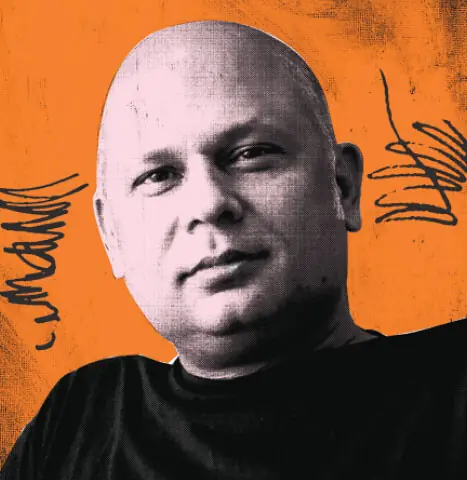
On the 21st of this month, Saqi Farooqi would have been 85 years old, had he continued to live among mortals. I had known this rebellious poet for a long time — a poet often abrasive and intensely passionate, not only in his social persona but also in his poetic diction. What is most significant, I met him during what were practically my formative years in London, and so he has some role to play in my own literary orientations.
He would quarrel all the time over literary issues with his friends, as I silently watched those historic jousts, but then he would affectionately shield me from getting caught in cross attacks. I lived not very far from him, and he visited me frequently. Many a famous poem of his I heard from him directly, such as his classic ‘Khaali Boray Mein Zakhmi Billa’ [Injured Cat in an Empty Sack] or ‘Sher Imdad Ali Ka Maindak’ [Sher Imdad Ali’s Tadpole].
I heard them more than once in his own highly dramatic declamations, a truly sensational performative style that I sometimes suspected to be artificially manufactured and contrived. His affection swelled when he found out that I am the son of Allama Saiyid Muntakhabul Haq, who happened to be his beloved teacher in Urdu College, Karachi, in the 1950s.
I have spoken of the Saqi ‘Phenomenon’ in my title, and he was indeed a phenomenon. For example, nobody in the history of the Urdu poetry of our times has used fear as a poetic device as we see in Saqi, especially in his early poems, such as ‘Naadeeda Aasmaani Balaa’ [Unseen Affliction from the Skies], ‘Manhoos Kooaan’ (Ill-Omened Well), ‘Veeraan Raat’ [Desolate Night], Kaali Aandhi [Black Dust Storm], ‘Sehr-Zada Shehr’ [Bewitched City] and so on.
Despite his belligerence, his frequent quarrels and abruptness, and his preoccupation with the weird, frightening and the grotesque, Saqi had a very soft and silky aesthetic sensibility too, as in one poem in which he says that he gets the feeling that a soul can be set ablaze by his voice, and can be cut open by the silk of his silence.
In fact, even towards the end of my companionship with Saqi in the mid ’80s, he told me how powerful and alive he found Mirza Asadullah Khan Ghalib’s verse, “The shadow of the rose branch appears to me like a venomous snake.” Evidently, this fear trope was with him till his last days, both psychologically and poetically.
But despite his belligerence, his frequent quarrels and abruptness, and his preoccupation with the weird, frightening and the grotesque, Saqi had a very soft and silky aesthetic sensibility too, as in one poem in which he says that, when he gets the feeling that a soul can be set ablaze by his voice, and can be cut open by the silk of his silence, this feeling is so life-nourishing that his eyes begin to sink, drenched in tears of joy.
Indeed, he often felt human inadequacies inflicted by nature in the depth of his creative being — infertility, blindness, impotency. The poignant lament of an infertile woman, ‘Baanjh’, is a masterpiece in terms of both its substance and technique: it has a cluster of contextually relevant rhyme words that form an integral whole, for all of these words, one way or the other, are appellative elements of childbirth — numood [appearance], kushood [expansion], wujood [existence], khwaab [dream], aazaab [affliction], aan [pride], kamaan [bow/ arch], jaan [life]. The poignancy in the finale of the woman’s lament is harrowing:
The arch of my pride is beginning to break
And I am losing my grip over life…
A dream they are,
An affliction —
Soft breasts, filled with
Warm milk for feeding!
Another feature of the Saqi Phenomenon is his relationship with animals and nature — figuring in his world are tadpoles, tigers, dogs, pigs, rabbits, trees. In fact, ‘Sher Imdad Ali’s Tadpole’ is a terrifying and haunting narrative story of a man hounded by a tadpole that enters his body, a story that involves the whole community of frogs. No such poem is to be found or even expected in Urdu poetry.
In my final days with Saqi, I heard him speak about Noon Meem Rashid quite a lot. In fact, he would pick fights with Rashid’s detractors — and there were many. The influence of Rashid is clearly discernible in some of Saqi’s later poems, such as his ‘Injured Cat in an Empty Sack’. Again, this is practically a ‘screenplay’: a man called Jan Muhammad Khan is carrying an injured (male) cat in an empty sack to commit it to a filthy pond, to drown the animal and get rid of it for good. Note that such acts of eliminating domestic cats is not unknown in South Asian culture.
The cat, in its heart-rending plea, reminds the protagonist of his own end one day, but the man fails to recognise the ‘sack’ that awaits him. One of the most remarkable features of this poem is its rhythmic structure. Lines appear in ever new notes, like unexpected waves rising in an ocean, or a new surprising turn in a symphony. A line that suddenly emerges is a rhythmic glory:
“Aur badan mein raat phhailti jaati hai” [and through this body, night is spreading]. And again:
“Aur main apnay taaboot ki tanhai se lipat kar so jaoon ga Paani paani ho jaoon ga” [With the silence of this coffin clinging all around me I shall sleep Becoming water again]
I must acknowledge my debt to Faruq Hassan’s thorough study of Saqi. The translation of the ‘Injured Cat’ is Rafey Habib’s.
The columnist is dean of the School of Liberal Arts at the University of Management and Technology, Lahore, and visiting scholar at the University of California, Berkeley
Published in Dawn, Books & Authors, December 12th, 2021