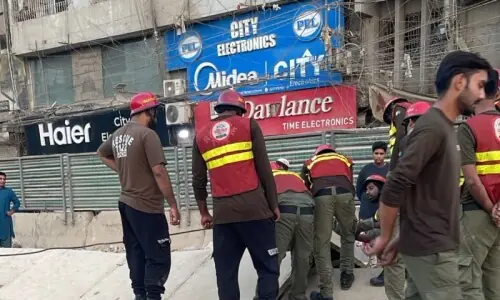
IN the run-up to World Human Rights Day observed last week, Pakistani society exposed its worst instincts as a mob lynched a factory manager and an infuriated crowd allegedly stripped four women rag-pickers. What was also apparent was the state’s inability to act in time. Or did it deliberately keep itself in the dark?
It is, in fact, a selective blindness that prevents the state from ensuring the fundamental and constitutional rights of the people, in spite of the laws of the land and the international conventions it has ratified. Indeed, it is dichotomous approach: on the one hand it has professed its aim of truly becoming a welfare state, whereas on the other it has turned a blind eye to the people’s sufferings, and in fact, has become a party to them — as evident in the massive eviction drives in urban areas that has left thousands without a roof over their heads.
This year’s theme for World Human Rights Day, ‘reducing inequalities — advancing human rights’, is an apt reminder of the many deadly blows that have been dealt to the already fragile state of equality and justice in the country.
We have seen peaceful protesters such as teachers, students, health workers and residents, whose homes have been reduced to rubble, encounter the full might of the state, whereas tolerance is reserved for ultra-conservative elements who control the streets or even kill and maim in the name of religion. Similarly, there are those who go missing when they raise a voice for the rights of their people, never to be seen again, while there is no accountability of the elements whose actions led to their disappearance in the first place.
Read: Raw deal for missing persons
Unfortunately, when the state does not believe in an even-handed approach in the application of justice, a sense of impunity seeps into society itself — not surprising when we consider that the public takes its cue from those who govern them. Unfortunately, successive governments have viewed even basic human rights as acts of charity to be dispensed at will. This mindset is reflected in practically all spheres of life, including the justice system itself. And it is what prevents the state from investing in policies and institutions for human and social development that could have rescued the people from the forces of exploitation. Respect for human rights in the country can only be instituted when the state is ready to admit and rectify its own approach.
Published in Dawn, December 13th, 2021