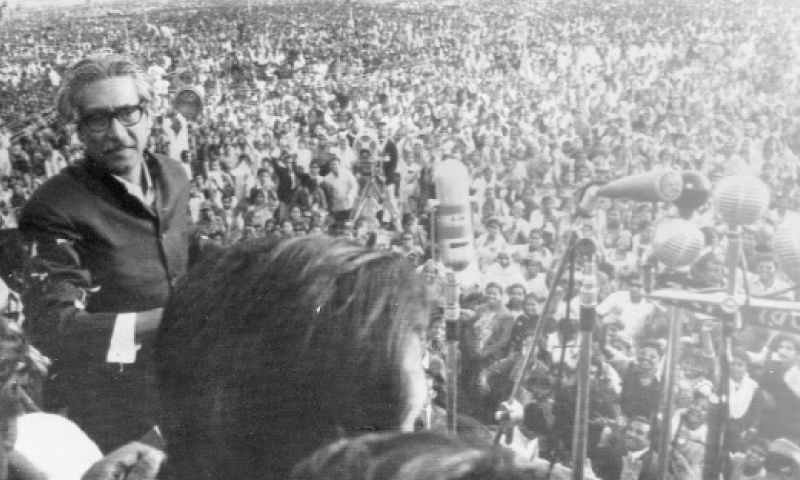
FIFTY years ago on this day, Pakistan’s eastern wing broke away to form the independent nation of Bangladesh following a bloody spasm of violence. It was a tragedy of immense proportions but the denialism that existed in 1971 among residents in the west wing still pervades our national consciousness today.
That year, the day after Dhaka fell, newspapers carried headlines quoting the then president and military ruler Gen Yahya Khan as saying that the war would continue till victory. A less conspicuous news item carried truer details: Indian troops had entered Dhaka and fighting had stopped “following an arrangement between the local commanders of India and Pakistan…”. While for West Pakistanis Dhaka had fallen, most in the eastern wing saw it as ‘liberation’. Censorship had kept West Pakistanis in the dark about the situation.
Read more: Sheikh Mujib didn’t want independent nation, documentary reveals
Half a century later, many questions still remain unanswered. For instance, why, for decades, was the population of East Pakistan treated as second-class citizens resulting in their alienation from the state? Ayub Khan’s One Unit scheme merging West Pakistan’s provinces to create ‘parity’ between both wings was actually an attempt to counter the eastern wing’s numerical majority.
Read more: Half a century ago
Unfortunately, successive governments in Pakistan have failed to officially release the Hamoodur Rahman Commission report that probed the debacle. Whatever of its contents are known serves as an indictment of the policies of the then federal government vis-à-vis the East Pakistanis. Indeed, the Indians played a reprehensible role by meddling in the country’s internal affairs. But it was united Pakistan’s own weaknesses that allowed them to do so.
One of the most egregious mistakes was to deny the majority their right to form a government after the 1970 elections. Instead, a military operation was launched in March 1971 in the eastern wing. Thousands fled to India for refuge. Innocent people were killed on both sides — Bengalis as well as non-Bengalis living in the eastern wing — by state forces and Bengali militias.
Read more: Transfer of power
Unfortunately, few lessons have been learnt from that tragedy. Denying people their rights, including the right to information, imposing the will of the few on the many, and resorting to authoritarian tactics are still the preferred methods of those who control the levers of power in Pakistan.
Fifty years later, a thorough and honest national debate is still pending on the separation of the eastern wing so that the mistakes of the past are not repeated. If a section of people agitates for their rights, they are not working against the state; they are simply seeking the fundamental safeguards promised to them in the Constitution — they cannot be termed traitors as they were in East Pakistan. Evolving better ties with Bangladesh is in Pakistan’s interest but fulfilling the social contract at home, between citizens and the state, must also be on the list of priorities.
Published in Dawn, December 16th, 2021