Petroleum prices may go up by Rs10 per litre
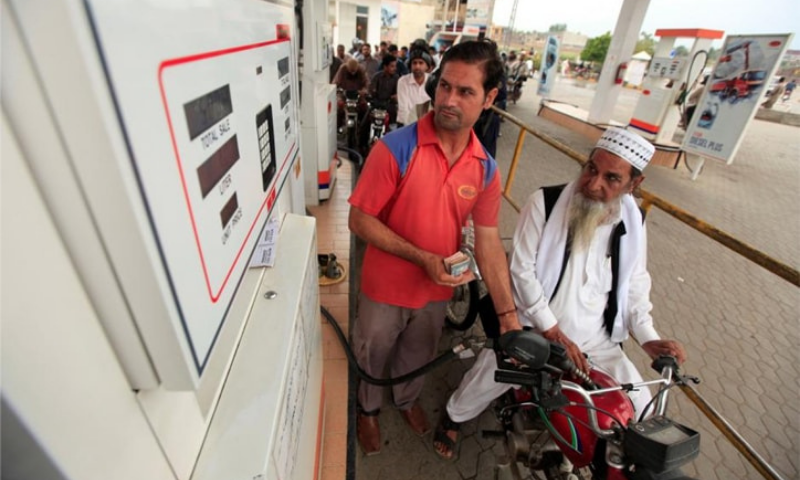

ISLAMABAD: Prices of all key petroleum products are estimated to go up by Rs8 to Rs10 on Monday for the next fortnight, mainly because of higher international oil prices, application of additional petroleum levy and currency devaluation.
The benchmark crude price has increased from $95 per barrel to $99 in the international market over the past fortnight of import orders placed by oil marketing companies while the exchange rate has slightly depreciated.
Informed sources said that based on the existing tax rates, import parity price and exchange rate, the prices of petrol (motor gasoline) and high-speed diesel (HSD) had been worked out to go up by about Rs5.60 and Rs4.50 per litre, respectively. Likewise, the prices of kerosene and light diesel oil (LDO) have been estimated to go up by about Rs4 and Rs3.70 per litre, respectively.
Earlier on February 15, the government increased petroleum levy on all petroleum products by Rs4 per litre as per commitment made with the International Monetary Fund (IMF), while to contain inflationary impact, sales tax rates had been reduced to zero on all products.
PM’s economic team to suggest increase in view of upcoming IMF quarterly review
If the government decides to continue with the practice of Rs4 per litre monthly increase in petroleum levy, the increase in ex-depot sale price of petrol is estimated at about Rs9.60 per litre, followed by Rs8.50 for HSD.
An official said the prime minister might like to postpone a further increase in petroleum levy, but with the next quarterly review of the IMF programme only a few weeks away, his economic team wanted to follow the international price trend along with all the existing taxes to stay the course.
Currently, general sales tax is zero on all key products, including petrol, HSD, kerosene and LDO, against 17 per cent normal GST, as the government slightly reduced GST on major products in January and brought it down to zero earlier this month.
However, the government has been raising the rate of petroleum levy by Rs4 on the first of every month, except for the current month, as part of the commitment with the IMF to take it to Rs30 per litre. Currently, the government is charging petroleum levy of Rs17.92 per litre on petrol, Rs13.30 on HSD, Rs9.50 on LDO, Rs5 on kerosene and Rs30 on high octane blending component.
The ex-depot price of petrol currently stands at Rs159.86 per litre and that of HSD at Rs147.83. Petrol is mostly used in private transport, small vehicles, rickshaws and two-wheelers and has a direct bearing on the budget of middle- and lower-middle classes, while HSD price is considered highly inflationary as it is mostly used in heavy transport vehicles, trains and agricultural engines like trucks, buses, tractors, tube-wells and threshers.
At present, LDO’s ex-depot price is Rs123.97 per litre and kerosene rate is Rs126.56. LDO is consumed by flour mills and a couple of power plants, while kerosene is mostly used by unscrupulous elements for mixing it with petrol and to some extent for lighting in very remote areas.
The petrol and HSD are two major products that generate most of revenue for the government because of their massive and yet growing consumption in the country. Average petrol sales are touching 750,000 tonnes per month against the monthly consumption of around 800,000 tonnes of HSD. Sales of kerosene and LDO are generally less than 11,000 and 2,000 tonnes per month, respectively.
Under a new mechanism, oil prices are revised by the government on a fortnightly basis to pass on international prices published in Platt’s Oilgram instead of previous mechanism of monthly calculations on the basis of import cost of Pakistan State Oil.
Published in Dawn, February 26th, 2022