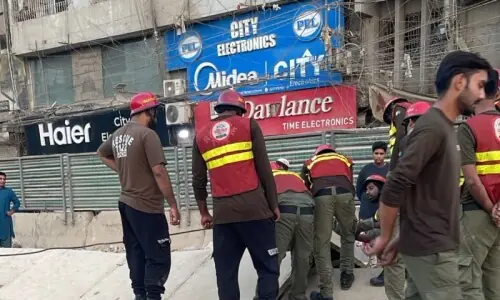
EVERY year there are boiler explosions in various factories across the country, killing many and leaving scores of others injured. There are several cases, particularly in small towns and industrial areas, that are never even reported.
According to the joint estimates of the International Labour Organisation (ILO) and the World Health Organisation (WHO), almost two million persons die globally every year due to work-related causes. This translates into some 5,500 deaths every day, or over three deaths every single minute. As many as 65 per cent of these deaths occur in Asia where there are gross violations of the national and international rules, regulations and practices related to occupational safety and health.
In Pakistan, the conditions are worse. Most of the 62 million employed workforce, including women and children, happen to be poor, illiterate and semi-trained, and thus exposed to various occupational hazards. The working conditions and environment in most of the workplaces are sub-standard and there is no concept of taking preventive measures to protect the life and health of workers.
Pakistan has a history of industrial accidents due to poor infrastructure, lack of safety standards, and laxity on the part of law-enforcing agencies. There is no record-keeping and data collection of accidents and incidents in the unorganised sector that mostly go unreported. The sector, mind you, employs two-third of the total non-farm workforce.
The work culture inhibits the labourers from taking safety precautions, like using protective clothing and equipment, when made available at the premises, and disseminating information about diseases they may acquire at workplace. Thus, practically no reliable statistics are available at the national level regarding work-related accidents, injuries, and diseases, whereas thousands of workers are routinely forced to work daily in hazardous conditions.
The range and scope of occupational safety and health covers all the industrial, commercial, agricultural, and service sectors, utilities, manufacturing, transport/communications, hotels/restaurants, mining/quarrying, construction, the SMEs, etc.
Nonetheless, the high-risk areas relate to the manufacturing, mining, power generation and transmission, and construction sectors. Major industries, like textile, leather, paper, metal, rubber, fertiliser, paint, cement, plastic, and ceramics, generate significant environmental hazards, and resultantly cause illnesses and injuries not only to the workers but also to the general public.
Work-related diseases range from tuberculosis in mine workers to carpal tunnel syndrome in computer users. The common diseases are asthma, skin disease, allergies, and stress-related illnesses. Work-related cancer has also been observed in various cases, which results from the unsafe use of chemicals and radioactive materials.
Traumatic injuries relate to electrical and construction industry, whereas muscoskeletal disorders result due to manual lifting and logging operations. Disabilities related to machine operations are common. The use, handling of or exposure to asphalt, bitumen and mineral oil is injurious to health. Shipbreaking, fisheries, agriculture and forestry are considered high-risk sectors, but are not given recognition as such.
In recent times, an increasing emphasis has been placed worldwide on addressing the issues related to the promotion of basic human rights, social justice and improvement in labour conditions. Consequently, the promotion of occupational safety and health has assumed greater relevance and significance. As a result, various governments are taking measures to ensure safe and healthy conditions for the workers through legislation, infrastructure development, institutional mechanism and capacity-building.
In Pakistan, the government, the employers and society at large remain insensitive to the major problems of safety and health. The only exception is perhaps those engaged in oil and gas exploration and production activities.
Pakistan’s current laws on the subject are obsolete and do not conform to the modern international practices. Also, the numerous laws on the occupational safety and health at federal and provincial levels, instead of a single comprehensive law, result in numerous anomalies and loopholes.
Hussain Ahmad Siddiqui
Islamabad
Published in Dawn, March 17th, 2022