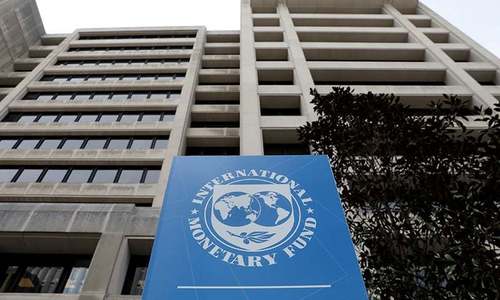
The International Monetary Fund (IMF) on Monday said that there was "no concept of suspensions" within its programmes and that it will continue to support Pakistan and engage further "once a new government is formed" in the country.
The statement from the Washington-based crisis lender comes amid political chaos in the country, especially in the aftermath of President Dr Arif Alvi's dissolution of the National Assembly following the dismissal of the no-confidence against Prime Minister Imran Khan the same day.
According to the IMF-Pakistan spokesperson, the Fund will engage in policies to "promote macroeconomic stability and enquire about intentions vis-a-vis programme engagement" with the new government.
Following the Fund's announcement, the Ministry of Finance also issued a press release stating that the Finance Divison and the IMF were engaged in data sharing and reform discussions as part of the Extended Fund Facility (EFF).
"There is no truth to speculation about [the] suspension of [the IMF] programme. IMF has confirmed the same and also clarified that it remains committed to Pakistan’s macroeconomic stability," the press release added.
The IMF had expressed its reservations over the government's recently announced amnesty scheme and shared doubts over the financial impact and financing sources of the prime minister’s relief package on electricity and petroleum prices.
Also read: IMF approves $6 billion loan for Pakistan
Dawn earlier reported that the Fund’s mission and the government authorities were unlikely to conclude the ongoing seventh review of the $6 billion EFF shortly and may lead to the disbursement of about $1.9bn worth of two tranches close to the federal budget due in June.
The mission was completely dissatisfied with the arguments advanced in favour of the money-whitening scheme for the industrial sector.
The Fund is critical of the third tax amnesty scheme introduced by the government despite a recent withdrawal of tax distortions by removing GST exemptions as part of the mini-budget agreed under the sixth review, which led to the revival of the EFF after a nine-month suspension and then disbursement of over a $1bn instalment.
The talks on the seventh review of the $6bn Extended Fund Facility started on March 4. The Fund had been concerned over the “one step forward, two steps back” approach of the government on critical reforms having serious budget implications going forward.
There are three critical areas, including tax amnesty, untargeted subsidy on petroleum products and general subsidy on electricity rates. These are estimated to drive the primary budget account — the gap between revenues and expenditures minus debt servicing — from a targeted Rs25bn in surplus to about Rs650bn in deficit by end-June, when the current fiscal year ends.
Pakistan has so far received little over $3bn out of $6bn worth of the 39-month IMF programme. The Fund earlier expressed concern over expansionary policies adopted in the 2021-22 federal budget, which it said had created fiscal imbalances, leading to the introduction of a mini-budget in December to address these slippages.
The IMF had in June 2019 approved a three-year, $6bn loan "to support Pakistan’s economic plan, aimed at returning "sustainable growth to the country’s economy and improving the standards of living".
The 39-month IMF programme is scheduled to end in September.