The State Bank of Pakistan (SBP) has raised its key policy rate again — this time by 125 basis points to 15 per cent. Meanwhile, the central bank has linked the interest rates on Export Finance Scheme (EFS) and Long-term Finance Facility (LTFF) to its policy rate “to strengthen monetary policy transmission.”
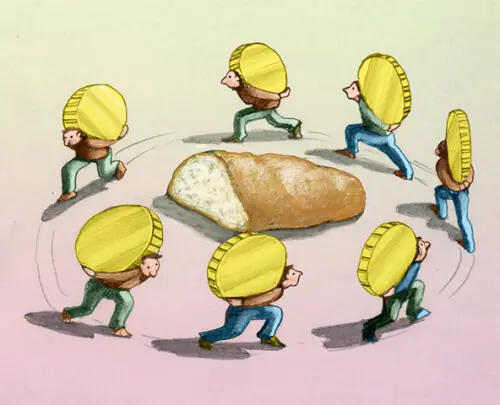
Effective monetary policy transmission — or markets behaving in line with the monetary policy decisions — has remained a challenge. When despite the tightening of interest rates inflation does not come down to targeted levels within a specified period, the central bank knows what’s wrong.
Apart from several other reasons, one thing that creates this situation is that inflationary expectations continue to remain in place. Companies factor in future inflation in their total cost calculations and continue to raise the prices of their products. And markets expecting inflation to remain strong despite monetary tightening behave accordingly: they remain engaged in high activity instead of showing signs of a slowdown.
The end result is that a tight monetary policy takes too long to dampen demand and bring stability to prices which is the primary aim of monetary tightening.
A tight monetary policy takes too long to dampen demand and bring stability to prices which is the primary aim of monetary tightening
With the central bank’s decision to link future lending under EFS and LTFF with its policy rate, the SBP has signalled to firms that in future they would get concessional finance from banks under these and similar schemes but the extent of concession would be limited. The central bank has announced that now it would incentivise exporters through the EFS and LTTF by offering only a discount of 500bps relative to the policy rate.
This means that eligible borrowers would now be able to borrow from banks under these schemes at 10pc till the time the policy rate remains at 15pc. This, obviously, is a good move. Offering too large a concession to companies makes little sense because when they borrow at nominal rates even during a tight interest rate regime, they continue to produce and invest in near-future business expansion. And that frustrates the basic purpose of monetary tightening ie containing inflation through dampening the aggregate demand, discouraging spending and promoting savings.
During the last fiscal year that ended in June, the SBP raised its policy rates five times to take it from 7pc in June 2021 to 13.75 in May 2022 — a cumulative increase of 650bps. Despite that headline inflation more than doubled from 9.7pc in June 2021 to 21.3pc in June 2022. Average inflation for the last fiscal year July-June 2021-22 also rose to 12.2pc from 8.9pc in July-June 2020-21.
The SBP admits in its latest monetary policy statement that the sharp increase in June 2022 inflation was broad-based — with energy, food and core inflation all rising significantly. Food inflation in June was recorded at 24pc in urban areas and 27pc in rural areas. An even more disturbing fact is that in June 2022 Wholesale Price Index — a measure of inflation at the wholesale level — showed a 38.9pc increase over a year.
These numbers are mind-boggling and hide behind them countless stories of human deprivation, hunger, starvation, chilling experiences of rising poverty and falling real incomes. Headline inflation of 21.3pc in June 2022 means a fall of about a quarter of purchasing power within a year. A family that earns Rs100,000 in June 2022 could buy goods and services that were worth only Rs78,700 in June 2021.
The SBP keeps offering reasons for inflation rising too fast throughout the last fiscal year and for hitting a 14-year high level in June. We all know about it now — higher global fuel oil prices, withdrawal of subsidies from energy products at home, stronger-than-expected post-Covid recovery of the Pakistan economy, rupee depreciation, food supply shocks etc.
However, as genuine these reasons may be, they can only satisfy the inquisitive minds of the students of economics but cannot calm the agitating minds of the tens of millions of financially poor people who cannot brave 15-20pc inflation anymore.
But bad news for them, in particular, and for all Pakistanis in general is that inflation isn’t going to come down in the near future. The SBP says that “despite the dampening effect of fiscal and monetary tightening on demand-pull inflation, inflation is likely to remain elevated around current levels for much of FY23 due to the large supply shocks associated with the necessary reversal of fuel and electricity subsidies.” It warns bluntly that inflation in this fiscal year starting July is forecasted at around 18-20pc.
What makes this warning even scarier is that the SBP says even “this baseline outlook is subject to significant uncertainty, with risks arising from the path of global commodity prices, the domestic fiscal policy stance and the exchange rate.”
Regardless of how global commodity prices will behave in the future, the risks associated with the possible loosening of fiscal policy and further rupee depreciation seem real. The rupee that lost 30pc of its value against the US dollar in FY22 may lose a bit more value in FY23 because no impactful improvement in the external sector can take place within a year, more so in the backdrop of an exceptionally large trade deficit of $48.2 billion in FY22.
Published in Dawn, The Business and Finance Weekly, July 13th, 2022