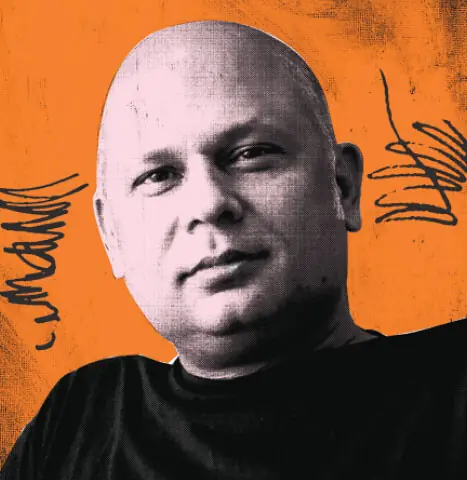
The author of Best of Friends — a novel about the dynamics of female friendships changing over a period of decades — speaks to Eos about themes, inspirations, identities and the joy of writing about 1980s’ Karachi pop culture
With your eighth novel now out, it’s been a grand career. Tell us how far — or how near — you’ve come since your debut book, 1998’s In the City by the Sea.
Thank you, but even I’m losing count at this point. It’s been nearly 25 years since In the City by the Sea was accepted for publication — I was 24 years old, to spare anyone else doing the maths — and it’s impossible for me to separate adulthood itself, in its different phases, from my life as a published writer. Certain things have changed, of course. I’m more confident and ambitious in my work, I’m able to live financially off my writing, I no longer say ‘yes’ to everything I’m asked to do or everywhere I’m asked to go, just because I’m so delighted to have any opportunity connected to being a writer.
What hasn’t changed is the feeling of writing itself. On the worst days, the words feel dead on the page. On the best days, I feel a peace and fulfilment that is uniquely about doing the thing I’ve loved all my life and knowing that — on this day at least — I’ve done it well.
Increasingly, your novels seem concerned with women and their interiorities, rather than outward engagements. What has prompted this movement in your work?
I had to pause at this question to wonder if it’s true. The previous two books — Home Fire and A God in Every Stone — give more space to male than female characters and are hardly short on outward engagements. And if you ask me to talk about Best of Friends, I’ll soon start talking about the Zia-to-Benazir transition of 1988 before moving on to the different kinds of power my characters wield in the Britain they’re living in as adults.
Yet, now that you’ve made me think of it, I realise you’ve picked up on something in my work that’s clearly there, but which I haven’t consciously thought about because so much of writing comes from our own internal shifts and concerns, which then make their way out into the writing. This is another way of saying that the movement in my work must reflect a movement in my own concerns — which is certainly not a shift away from outward engagement, but a more reflective position about what it is to be a woman in a world in which the power structures are created by and for men. This isn’t unrelated to the fact that, in my experience, women in their 40s simply talk a lot more about their interior lives than at earlier stages, so the internal shift I’m talking about is fed by the conversations I’ve had with friends in the last decade.
Karachi is almost never absent from your novels, but increasingly London has gained prominence. How has living in the two cities affected your understanding of citizenship and identity in these times?
I never had to think about citizenship when growing up in Karachi because I could simply take it for granted, but I moved to London at a time when two things were happening: one, the laws for citizenship acquisition started to get much tougher as a result of anti-migrant sentiment and two, conversations started — post the 7/7 bombings — about the definition of ‘Britishness’ as a set of values separate to citizenship. The latter was clearly a way of saying that some people who’ve been British all their lives aren’t ‘really’ British — a convenient way for Britain to pretend it played no role in the violence and alienation of parts of its own population who had never lived anywhere but Britain.
As a result of all this, I’m clearer than ever in my mind that citizenship should only be seen in legal terms: you have certain rights as a citizen, irrespective of how long you’ve been a citizen or where your family has its roots. Beyond that, anyone who tries to define what it means to be British or Pakistani, or anything else, usually has a pretty nasty agenda of exclusion going on.
My response to the word ‘identity’ is similar. I’ve always regarded it as a capacious word, speaking to our human ability to inhabit many, often contradictory, selves and to hold affinities separate to our lived experience. I’m made up of the books I’ve read as much as the cities I’ve lived in, so I’m not particularly interested in a conversation about identity that wants to narrow us down to boxes you can tick on a census form.
What novels, texts or films did you engage with that may have helped shape your book?
It’s hard to write a story about female friendship without being aware of Italian novelist Elena Ferrante. What I particularly love in her four-part Neapolitan Novels series is how she shows us that the violence of a society works its way into the lives of all the characters who live there. She’s telling us this really intimate story of friendship, but it’s also a story of a time and place. That’s something I hope I’m doing in Best of Friends with both Karachi of the ’80s and Britain today.
But I also wanted to tell a story of female friendship very different to the one Ferrante gives us, which has antagonism and sexual jealousy at its heart. I wanted it to always be clear that Zahra and Maryam deeply love each other, through all their differences. Whether that love is enough to sustain the friendship through its difficulties becomes the question.
But honestly, one of the great joys of writing the book was being able to refer to all the ’80s pop culture that my own growing-up was infused with. I loved being able to write about video shops on Boat Basin, [the television quiz show] Neelam Ghar and Jackie Collins.
What advice would you share for aspiring young women writers?
The most important advice I ever received was from my mother’s chaachi [paternal aunt by marriage], the novelist Attia Hosain, when I was 11 years old. She said that, no matter what anyone says about your writing, no matter how disillusioned you feel, keep writing. Because writing is a muscle — if you don’t use it, you might lose it forever.
I’ll add this: believe that your writing life is long. That way you don’t have to put everything you want to say in a single story or novel, and you don’t have to believe that whatever obstacles are in your path will always be there. Just write and keep writing — the muscle will strengthen over time and new things will become possible.
What can we expect from you in the next few years?
I never have the faintest idea what I’m going to do next, or how the world might spin me in one direction or the next.
Published in Dawn, Books & Authors, October 2nd, 2022