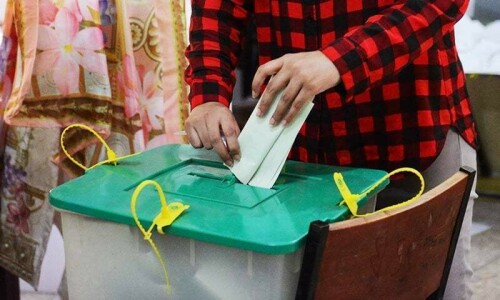
THE Election Commission of Pakistan (ECP) has dismissed the Sindh government’s latest request to delay local government elections in Karachi for the third time this year. The Sindh government had made the request after the Sindh Police chief told the provincial government that he could not spare enough cops for the elections exercise due to the police force’s engagement in ongoing rain and flood relief work.
Separately, the reigning city administrator had also hinted at the possibility of another postponement.
However, the ECP has insisted that the Sindh government deploy police from districts relatively unaffected by floods and ensure polling goes ahead according to schedule in the city’s seven districts on Oct 23.
Karachi, which accounts for more than a third of Sindh’s population, remains at a strategic and political disadvantage. For many years, various provincial departments have controlled Karachi’s affairs. Crucial decisions about mega transportation projects, institutional revamping and new real estate developments have been made in a non-participatory manner. For obvious reasons, holding local elections and constructing a viable tier of local government is not a priority for the provincial government.
In the past, too, local government elections in Karachi had only been held because of the strict orders of the superior judiciary. Interestingly, elected local governments in Karachi and elsewhere have been revived and empowered only when the military has directly ruled the country.
Generals Ayub Khan, Ziaul Haq and Pervez Musharraf ensured timely elections and empowered local governments. These attempts helped introduce a reasonably devolved system of local government. They promoted participatory democracy, capacity building at the lower levels, empowerment of vulnerable communities, enhancement of women’s participation in governance, and support for democratic practices at the grassroots level.
Karachi remains at a strategic and political disadvantage.
During the Musharraf era, Karachi was assigned the status of a city district. When the ‘democratically elected’ federal and provincial governments returned, they divided the city into fragments to do away with the strategic entity. If elections are to be held as per the current arrangement, the seven districts of Karachi will have 25 town administrations and 233 union committees. Whoever takes charge will have to deal with a complicated process of mayoral elections, watered-down powers and tightly controlled revenue options.
Editorial: Sindh LG poll mess
Therefore, to think that elected local government institutions will be able to address the chronic urban challenges Karachi faces is a fallacy. After the 18th Amendment, unprecedented financial resources have been allocated to the provincial government by the centre since 2010. Apart from these resources, the provincial officialdom has also seized complete control of all urban matters.
Thus, management and control of water supply, sewerage, solid waste management, urban and regional planning, urban transportation, land allocation and management, housing and infrastructure development, health, education, urban agriculture, industrial development, environmental control, building and zoning control, and many other areas now rest with the provincial government.
Some residual functions, such as selected parks and landscapes, urban drainage, and maintenance of a few roads and streets, have been left to the KMC. Town administrations and union committees, therefore, possess very rudimentary functions. Financial subordination automatically creates political and administrative subordination. While financial devolution enormously benefited the province, its advantages have not been devolved to the city. The provincial finance commission, an entity supposed to institutionalise the financial transfers from the province to the districts and other tiers, has seldom functioned. Karachi is thus dependent upon packages and grants from the federal government to manage routine affairs and development projects. One would be at fault for attaching any big hopes to such an arrangement.
However, suppose elected councillors mobilise and put up a united front to articulate common demands and negotiate a working equation with the provincial government. In that case, a win-win situation may emerge for the residents of Karachi. On the other hand, it will be interesting to see how the Jamaat-i-Islami’s (JI) sustained campaign will fare. Whereas its leadership and workers have been making the right demands for many years, it remains a question whether their charter will enable the JI to win enough seats in union, town and city councils.
Councillors must work out creative ways of revenue generation and tax sharing to ensure financial independence for the city. Options include variations of property tax, motor vehicle tax, environmental levies and logistics taxation. Political interest groups will only be able to bring respite to the long-suffering Karachiites after they secure healthy and sustainable revenue for the city.
Notwithstanding its heavy political baggage, Karachi occupies an extraordinary position in the administrative and political landscape of the country. This must be recognised in a step-by-step manner. A fundamental issue is related to the planning of the city, which has morphed into a sprawling urban region. Initial headway has been made to begin preparatory work on the Greater Karachi Region Plan 2047 by the provincial government, which should be followed up on rigorously.
Establishing an independent planning agency for the city is a rational way to plan and develop Karachi for the future. This agency should be entrusted with translating political objectives into viable planning and development options. Urban planners, economists, sociologists, architects, financial experts, engineers and legal experts may form the core team at this agency.
It can be concluded that a great deal of content and prosperity can be ensured for the city and the country by reducing ad hoc-ism and introducing transparency in state functions. It is up to the political leadership of all tiers to rise to the occasion, take responsibility, and deliver the residents some long-due good governance.
The writer is an academic and researcher based in Karachi.
Published in Dawn, October 6th, 2022