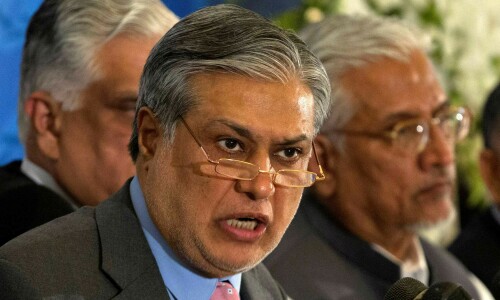
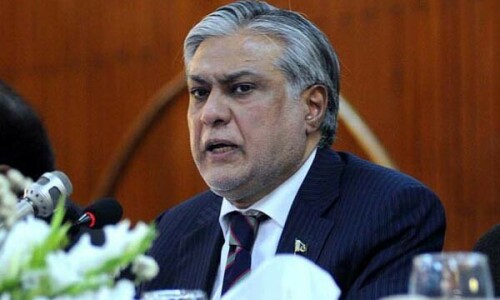
Is “Daronomics” or economic policies followed by our Finance Minister Ishaq Dar good or bad for our economy? Most commentators give a “yes” or “no” answer. However, this response is generally not based on objective criteria but on political partiality. This article presents a four-year comparison of three key economic indicators during the three previous governments. It also suggests the way forward where Daronomics did not work in the past.
GDP growth is the most important economic indicator, which shows whether our economy has expanded by producing more goods and services or contracted due to lower output. This indicator favoured Mr Dar’s performance, as GDP growth during his tenure was 4.3 per cent, compared to 3.5pc and 2.6pc during the PTI and PPP periods.
Keeping inflation in check is another important indicator, as an increase in prices has a huge impact on the lives of ordinary people. Once again, Mr Dar’s performance has been commendable. During his tenure, inflation averaged 5pc compared with 9pc during the PTI government and 13pc during the PPP regime. A caveat is that external factors such as commodity and energy prices have always influenced domestic inflation rates.
Finally, how did our exports fare during Mr Dar’s earlier stint? Unlike the two previous economic indicators, the data shows Mr Dar’s performance was much below par. As compared to a growth of 37pc and 23pc during the PPP and PTI regimes, respectively, exports fell by 10pc during Mr Dar’s period.
Energy subsidies of about Rs100bn to exporting sectors means exporting subsidised energy to other countries
Many blame Mr Dar’s exchange rate policy for making our exports non-competitive. But this may not have been a significant factor as Pakistan’s previous experience shows that our exports grew faster when the rupee value was stable than when our currency was weak. Our neighbours like India and Bangladesh had the same experience.
Empirical reasoning would suggest that Mr Dar’s regressive taxation policies, particularly those relating to customs duties, impaired our exports. A big jump in customs duties reversed most of the gains made over the last twenty years of tariff reforms. As a result of these new tax measures, the share of customs duty in tax revenue jumped by over 50pc during his period. According to the Lerner Symmetry Theorem, export taxes and import tariffs have symmetric effects on trade. This means that import duties are equivalent in their effects to export taxes.
While the new duties and other import taxes resulted in an increase in tax to GDP ratio from 9 to 11.2pc, these taxes had a far bigger negative impact on exports, which fell from 13.3pc of GDP to 8.2pc. Some customs duty increases, particularly on industrial raw materials, were rolled back during the PTI era, but most additional and regulatory duties are still in place. Even books and other scientific materials, which had always been exempt as Pakistan is a signatory to the United Nations Educational, Scientific and Cultural Organisation agreement, were not spared and subjected to customs duties.
Instead of focusing on tariff reforms to remove anti-export bias, Mr Dar seems to be banking on giving subsidies to some sectors. He has already announced energy subsidies of about Rs100 billion to five exporting sectors. Being an energy-deficient country, it would mean exporting subsidised energy to other countries. Additionally, subsidies to some sectors put other businesses at a disadvantage. They also distort investment and further narrow the export-basket range.
We also have to be mindful that if our exports in the subsidised sectors make any substantial inroads in the EU and US markets, they are likely to impose anti-subsidy duties as has been done in the past. Thus, foreign governments will likely collect a major share of the subsidy given to our exporters.
The only way forward is to emulate the policies of other successful game changers like Turgut Ozal, Deng Xiaoping, or Manmohan Singh. These leaders changed the direction of their countries’ economic thinking from import-substitution models of trade and development to export-led growth.
They achieved this through gradually lowering import tariffs, removing nontariff barriers and opening their countries to foreign investment. These are tried and tested policies that brought success to scores of other developing countries as well. Export subsidies and high tariffs have not worked for any country and are not likely to work in our case. If we want to promote our exports, there is no alternative but to open our economy to competition.
The writer is currently serving as an international trade arbitrator and has previously worked as Pakistan’s ambassador to the World Trade Organisation at Geneva
Published in Dawn, The Business and Finance Weekly, October 24th, 2022