Hyderabad will be Pakistan’s hottest city by 2100: UN


WASHINGTON: In Pakistan, Hyderabad is likely to be the hottest city by 2100 with the highest average temperature reaching 29.9°C to 32°C followed by Jacobabad, Bahawalnagar, and Bahawalpur cities, warn two UN reports released on Wednesday.
“In South Asia, extreme climatic conditions are threatening food security; thus, agro-based economies, such as those of India and Pakistan, are the most vulnerable to climate change,” says a new report by UN Climate Change (UNFCCC).
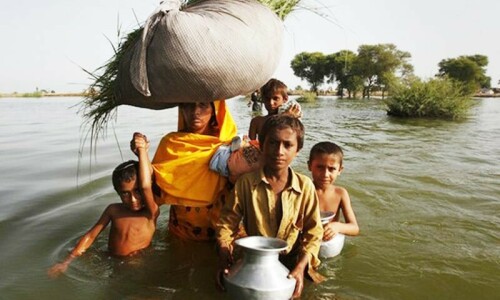
“In Pakistan, farmers are experiencing a decline in crop yields and increasing incidence of crop diseases as a result of climate extremes, particularly floods,” the report points out. “Water stress is likely to be more pronounced in Pakistan, and northern parts of India and China”.
Read: Heatwaves, flood, drought: four in five of world’s cities at risk, study shows
The reports note that global efforts to tackle emissions and mitigate climate change were not having the desired impact and the planet earth was getting warmer by at least 2.5 degrees, a level deemed catastrophic by most scientists.
The reports project that by the end of the century, South Asia will have “more intense heatwaves of longer durations and occurring at a higher frequency,” particularly in India and Pakistan.
People living in 330 cities above 300,000 population are already exposed to drought risk because of the heatwaves. Three Asian mega cities Delhi, Karachi and Kolkata are top on the list. “Drought-related economic losses are also high in Dhaka,” the reports add.
Explaining the impact of climate change in a larger context, the reports note that by the mid-21st century, the international transboundary river basins of Amu Darya, Indus, Ganges could face severe water scarcity challenges due to climatic variability and changes acting as stress multipliers. Noting that there has been an increasing reliance on groundwater in South Asia for irrigation, the authors show how India, Bangladesh, Pakistan and China together account for more than 50 per cent of the world’s groundwater withdrawals. Excessive withdrawals, the authors argue, will not only reduce availability of drinking water but will also increase contamination, making the water unsuitable for human consumption.
The reports describe the Hindu Kush Himalayan region, which extends over roughly 3,500 km, as one of the main sources of water for the South Asian region. The region includes eight countries: Afghanistan, Pakistan, Nepal, China, India, Bhutan, Bangladesh, and Myanmar.
The region is home to 10 major river basins that feed south and south-east Asia. Projections show that by 2050, more than 50pc of the population in Hindu Kush countries will live in cities.
Most of the towns in Hindu Kush Himalayan region meet their water needs using supplies from springs, ponds and lakes which are largely interlinked systems. “Water insecurity in hill towns is becoming the order of the day”.
Second, climate-induced changes in the physical environment include increased rainfall variability. Due to this, heavy rains are becoming frequent and are leading to more landslides. Third, global warming has increased the average temperature in the Himalayas which has caused glacier melt and subsequent change in hydrological regimes of the region. One of the contributing factors of glacial decline is also the deposition of black carbon, which is contributed by burning of crop residue in the Indian Punjab.
The changes have already started having a major impact on the larger South Asian region, as recent floods in Pakistan indicated.
Published in Dawn, October 27th, 2022