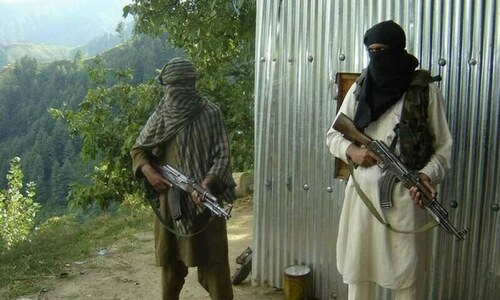
THE banned TTP’s formal announcement to call off a ceasefire it had agreed to with the government a few months ago requires an immediate and convincing response from the political and military leadership. Any new decision on dealing with the group should be made in an inclusive way and brought into the public discourse and debated in parliament. This is not merely a security issue but also a critical factor in our broader politico-strategic and geo-economic priorities.
The federal interior minister recently said the government hadn’t initiated any sort of formal dialogue with the banned group in the past. However, the security institutions and the civilian government both had started the recent, failed phase of talks with the TTP with much enthusiasm. There was much anticipation that the TTP would become more reconciliatory and some of its cadres would lay down their arms after the Afghan Taliban victory in Afghanistan. However, the interior minister has said that such talks ‘are held even in a state of war’.
What has happened since the Taliban takeover of Afghanistan in Pakistan is known to all, and there is not much left to celebrate as the Afghan situation has already started to hurt Pakistan’s security and economy. Most optimistic statements about the TTP talks are still fresh in people’s memory. When the TTP announced a formal ceasefire in May, state institutions freed some high-profile TTP leaders, including Muslim Khan, once considered the face of the TTP’s lethal Swat chapter. The formation of jirgas and other delegations and their negotiations with the TTP leadership in Afghanistan is also well known.
The decision of talking to the TTP was taken by the military leadership and endorsed by the PTI government. The current coalition government also owned it. However, two factors have dampened the optimism: the Afghan Taliban’s continuing political and military support to the TTP so that the group can achieve its objectives inside Pakistan; and the anti-TTP demonstrations by citizens of Swat and other KP districts. For the security institutions, the Taliban’s strategy vis-à-vis the TTP was understandable because both groups fought side by side in Afghanistan and have ideological and tribal connections. There was a perception that the relationship between the Afghan and Pakistani Taliban would gradually weaken. The massive protests against the TTP’s efforts to regroup in KP, which later expanded into Balochistan, also came as a surprise.
The Afghan Taliban have not yet given up their support to the TTP.
State institutions have tried hard to dispel the impression that there was any sort of deal involved in allowing the TTP militants to return; they even refuted ‘assumptions’ that the TTP terrorists were coming back. Still, the anti-TTP protests played a significant role in halting the talks. The state institutions took the demonstrations by citizens more cautiously and as a sign of deepening ethnonationalism, which they thought was more dangerous for state cohesion.
The TTP and other terrorist groups have been continuously launching terrorist attacks against the security forces. From January to mid-November, the group has launched 70 verified attacks against the security forces, which caused 105 fatalities among military, paramilitary, and police personnel as well as civilians. These attacks also caused anger against the militants. The security forces have launched counterattacks and killed dozens of key TTP and Gul Bahadur group commanders in recent months.
When the TTP announced the end of the ceasefire, it cited kinetic operations by the security forces including in Lakki Marwat district as one of the reasons behind their decision. According to reports, the military had besieged and killed TTP militants, who had taken police officials hostage and wanted to move them to Afghanistan. In the same district, the TTP killed six police officials in mid-November. The outskirts of Lakki Marwat and Bannu districts, that lie adjacent to the twin Waziristan districts, appear to have become the new hub of TTP activities.
The presence of TTP militants in these two districts strengthened the suspicion of the people of Swat and the tribal districts that the terrorists were on their way back to their towns. Local leaders from Swat also claim that the TTP had abandoned its positions in Swat because of the arrival of the harsh winter in Malakand division. Most probably, they moved towards the north-east of the province.
Apart from its incursions into Pakistan, the TTP is trying to recruit disillusioned youth with religious backgrounds. Reports of the TTP’s return have raised alarm across the country, particularly in KP and Balochistan. At the same time, the common man does not want the concentration of security forces to counter the militants in their areas as it disturbs their businesses and daily life comes apart because of constant fear and a sense of insecurity.
Whenever the new security leadership takes a decision on the future course of action, either talks or military action, or both at the same time, it should keep the common people’s apprehensions in mind. Though the federal interior minister is restating the official position that only those will be pardoned who lay down their arms, it should be kept in mind that the Afghan Taliban have not yet given up their support to the TTP. They will continue encouraging the militant group covertly, as both have a common ideological mindset and objectives.
Usually, security institutions tend to keep the broader picture of regional and strategic scenarios in mind while making decisions regarding domestic threats related to terrorism. They may overlook the Afghan Taliban’s position on the Taliban and also consider their limitations in the broader geostrategic and geo-economic contexts. Parliament and an open discussion at various societal levels can help bring clarity and set priorities without compromising on core objectives.
Most importantly, state institutions should not see citizens’ movements with suspicion, as support is crucial to winning the fight against terrorism and internal threats. Harassing and registering cases against pro-peace demonstrators is counterproductive and leads people to believe that state institutions are compromising their security to please the Taliban.
The writer is a security analyst.
Published in Dawn, December 4th, 2022