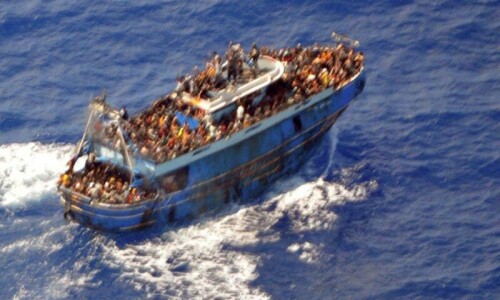
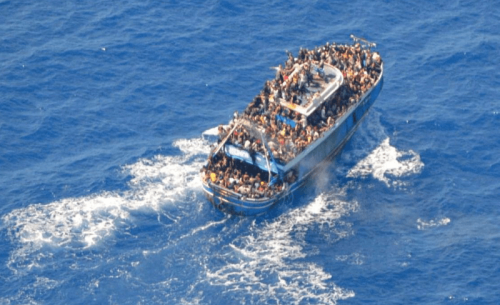
IT is unlikely that more survivors will be found. That means that at least 600 migrants — out of possibly 750 — on the fishing boat that set off from Libya towards European shores, may have perished when their vessel capsized in the Mediterranean on Wednesday.
The details are still sketchy but the passengers largely comprised Pakistanis, Afghans, Egyptians, Palestinians and Syrians. According to some reports, up to 300 Pakistanis may have drowned. It is a recurring tragedy — with no end in sight as economic, political and climate crises compel increasingly large numbers of people to flee their homes.
Who should be held responsible for this incident? The Greek coast guard that were not far off and that had, in fact, communicated with the people on the boat before it sank? If reports are to be believed, they tried to tow the boat. Did this is in any way contribute to the tragedy? But the larger question is, why in the presence of maritime authorities did a tragedy of such immense proportions take place?
Only a comprehensive, unbiased investigation can reveal what happened between the time the authorities were first alerted to the presence of the overcrowded boat and when the vessel capsized later at night.
Regrettably, the absence of help by the coastal authorities is part and parcel of Europe’s larger xenophobic policy that aims to keep migrants out.
However, Fortress Europe alone cannot be blamed for why people in developing countries, such as Pakistan, choose to leave. This is not the first time Pakistani migrants have lost their lives at sea.
There have been several incidents. In a particularly heartbreaking one earlier this year, sportswoman Shahida Raza, who was unable to afford medical treatment for her young son in Pakistan, drowned as the migrant boat carrying her and scores of others crashed against the rocks.
She had been attempting to reach foreign shores to build a better future for her child. Therein lies the tragedy: an inept, uncaring government has made little effort to crack down on a vast network of human smugglers who fleece desperate individuals and put them on a path strewn with hazards.
It is telling that in the latest incident, very few of the victims’ families registered a complaint against the human smugglers. Perhaps they did not expect anything to come of it or perhaps they feared harassment at the hands of the authorities themselves.
It is bad enough that the spectacular failure of the government to fulfil its part of the social contract by providing economic security to its citizens drives desperate individuals — even the educated ones — to leave the country.
It is a crime when the government decides to ignore a grave issue that has snowballed into a crisis of deadly proportions.
Published in Dawn, June 19th, 2023