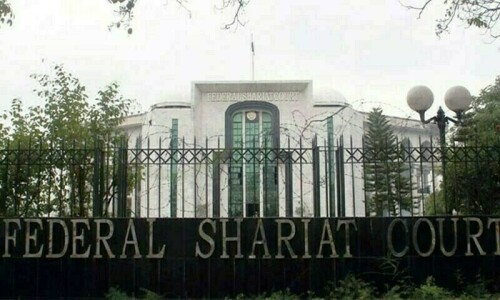
ISLAMABAD: Pakistan People’s Party (PPP) Secretary General Farhatullah Babar has challenged the verdict of Federal Shariat Court that struck down the Transgender (Protection of Rights) Act 2018 in May.
The civil appeal filed with the Shariat appellate bench of the Supreme Court of Pakistan by Mr Babar and Sherkan Malik pleaded that the Shariat Court verdict was “discriminatory, illogical, unlawful, unconstitutional and not founded on any sound legal or religious reasoning and is beyond the jurisdiction vested in the Shariat Court by the Constitution”.
Mr Babar, who is also president of the human rights cell of the PPP, contended that the Shariat Court verdict was more in the nature of a lecture on morality by the two justices rather than a decision based on the court’s jurisdiction.
He said the verdict failed to appreciate that Almighty created all humans, including transgender persons, who were entitled to certain rights inherent to all by virtue of being part of the larger humanity.
In a statement, Mr Babar said the verdict was contradictory in that while it recognised certain categories of genders other than male or female, it made the findings based only on two categories of genders namely males and females.
He said ignoring the plight of the transgender community was to ignore some of the most fundamental tenets of Islam and “the failure to acknowledge transgender persons right to exist leaves a legal black hole.”
If the gender identity of transgender persons was not affirmed by the laws of the state, they cannot be granted any further rights of protection from discrimination, of protection from harassment, he said.
The appeal urges the Supreme Court to set aside the Shariat Court verdict in its entirety as unlawful and unconstitutional and also to declare the Transgender (Protection of Rights) Act 2018 as a valid piece of legislation in their entirety.
The former senator contended that he participated in the parliamentary process and debates resulting in adoption of the Transgender Persons (Protection of Rights) Act 2018 and was also a member of the Task Force on Transgender set up by the federal ombudsman.
Mr Babar said under Article 203 (2) (b) of the Constitution no decision of the Shariat Court “shall be deemed to take effect before the expiration of the period within which an appeal therefrom may be preferred to the Supreme Court or, where an appeal has been so preferred, before the disposal of such appeal.”
He said under the law the government had six months to file appeal against the Shariat Court verdict but private petitioners only had two months to do so.
Published in Dawn, July 18th, 2023