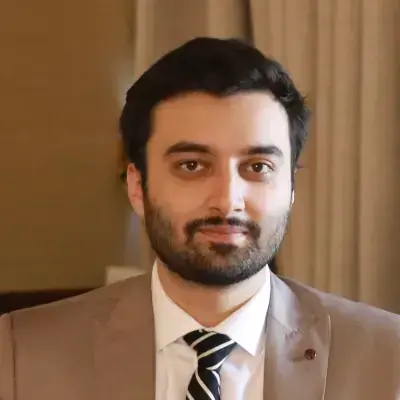
AS a person living with visual impairment, there are two things that you hear consistently at every stage in life. One: you’re such an inspiration. Two: you’re a cheater; a burden on society. My name is Mohammad Ali, and with the help of an old friend as co-author, I’d like to tell you a bit of my story.
The UNDP estimates that 6.2 per cent of Pakistan’s population has some form of ‘disability’. If you’re one of those 14 million people, your lived experience is one that isn’t shaped by your humanity, but by pity. You are the ‘other’, a strange creature that can be treated with the occasional benevolence, but never with equality.
Here’s an example; I did my ‘O’ and ‘A’ levels in Pakistan. I did well enough to get a scholarship to study law at New York University. I used screen reading software to study. In every examination conducted under these foreign bodies, I was treated with trust and respect. A scribe that I had hired and practised with would read out the questions, and I dictated back my answers to be put to paper, word for word, under an invigilator’s supervision.
It was only in the CSS, Pakistan’s most competitive exam, that this trust disappeared. When you ask for a scribe from the Public Service Commission on account of visual impairment, the government assigns you one of its employees. A stranger introduced to you on the day. One with no incentive to work effectively, or match your pace. You say the words. You hear a pen on paper. But you don’t know what they’ve written, and what they’ve left out. It is presumed that without this system, you will cheat. The government could invest in having one person watching over you to mitigate this, and give you a fair shot. But it won’t.
Those with disabilities are not a monolith.
People on the streets of Pakistan have told me with confidence that it’s better to not have life at all than to live with a disability like mine. But just because some might not see the validity of my existence doesn’t take away my right to live it on an equal playing field. Pakistan is a signatory to the UNCRPD, which mandates “necessary and appropriate modification and adjustments not imposing a disproportionate or undue burden” to ensure equality of opportunity for those with disabilities.
What this means is that solutions must be tailor-made to each disabled person’s individual circumstances, to ensure they are not left behind in the interest of majoritarianism. Those with disabilities are not a monolith. Some visually impaired people are comfortable with the use of braille. Some use software like JAWS. The hearing impaired require an entirely different set of resources. Without these individualised solutions, the state is making a decision to simply leave us behind.
Pakistan has taken some steps in the right direction towards inclusivity, but even where policy succeeds, implementation doesn’t. Consider the Sana Khurshid case, where Justice Jawad Hassan mandated the use of wheelchair ramps throughout Punjab. The judgement was great, but a short walk around Lahore will show the extent of its implementation. Elevators continue to shirk their legal obligation to use braille on their buttons. When I spent a semester abroad in London, I found accessibility built into the very streets I walked on, with every road featuring indents to guide me. They uplifted their most vulnerable citizens. They didn’t abandon them. In my home country, this simple act of walking on a street is impossible for anyone like me.
A positive aspect of disability is the amount of kindness and empathy you get to see in people, which I’ve found in every gracious stranger who helped me for no reason other than the goodness in their heart. I value it more because I have seen the opposite. I was abandoned by my father because it was presumed that I could never participate in the career he had imagined for me. But I’m proud to be raised by a mother who saw me for my humanity.
Empathy can be both a good and bad thing. Too much of it can foster dependency, like in ‘special schools’ that only serve to further alienate my community from the rest of society. Just like segregation didn’t work for race in the Jim Crow era, it won’t work for those like me. When races integrate, they find success. So do the differently abled. Stevie Wonder is loved not for being black, nor for being visually impaired, but for bringing joy to the world with his music.
That’s how I’d like to be known. Not as a disability. Not as a quota. But for my work, and who I am. Sympathy often comes from a place of kindness, so I appreciate it, even when I politely decline. Don’t feel sorry that I can’t see. Feel sorry for what societal ignorance is doing to me and millions like me.
Mohammad Ali is a disability rights activist and academic with a degree in law from NYU.
Hassan Kamal Wattoo is a lawyer and writer based in Islamabad.
Twitter: @hkwattoo1
Published in Dawn, August 11th, 2023