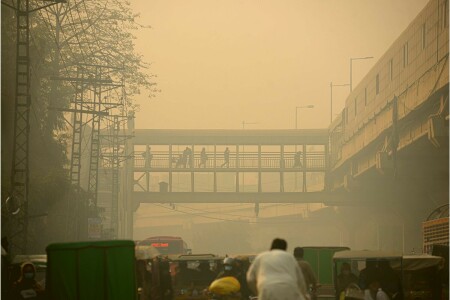
Air pollution cuts lifespans in Pakistan by up to 4 years


KARACHI: A rise in air pollution in Pakistan, particularly in highly polluted urban centres, could lead to a potential reduction of up to four years in life expectancy, according to the latest Air Quality Life Index (AQLI) report.
The annual report from the University of Chicago’s Energy Policy Institute indicates that those living in cities such as Lahore, Sheikhupura, Kasur and Peshawar could stand to lose up to four years of their lives.
As per the index, which quantifies the influence of air pollution on life expectancy, particulate pollution stands as the second most significant peril to public health in Pakistan, with cardiovascular diseases being the primary concern.
The rise in the pollution will also increase the occurrence of several mental health disorders like chronic anxiety, seasonal depression and mood sicknesses, the report predicts.
AQLI report classifies Bangladesh as top polluted country; New Delhi emerges as ‘most polluted megacity’
On a global scale, South Asia bears the brunt of severe repercussions. Bangladesh, India, Nepal, and Pakistan — home to nearly a quarter of the global population — are listed as the global epicentre of pollution, as indicated by annualised, population-weighted averages of fine particulate matter, detected through satellites.
According to the report, the entire 240 million population of Pakistan resides in regions where the yearly average of particulate pollution surpasses the guidelines set by the World Health Organization (WHO). These standards suggest that annual average concentrations of particulate matter (PM) 2.5 should not exceed five micrograms per cubic metre, while 24-hour average exposures should not exceed 15 micrograms per cubic metre more than three to four days per year.
Around 98.3 per cent of the country’s populace lives in areas where the annual average particulate pollution level exceeds Pakistan’s national air quality standard as well as WHO guidelines for air pollution.
According to the report, residents of Punjab, Islamabad, and Khyber Pakhtunkhwa are projected to experience a decline in life expectancy ranging from 3.7 to 4.6 years on average if current pollution levels persist.
Furthermore, the AQLI report reveals that between 1998 and 2021, the average annual particulate pollution in Pakistan experienced a surge of 49.9pc, leading to a reduction of 1.5 years in life expectancy.
The report further details that if Pakistan were to adhere to the WHO guideline, inhabitants of Karachi could potentially gain three years in life expectancy, while those in Lahore might gain eight years and residents of Islamabad could see an increase of around five years in life expectancy.
Global impact
Bangladesh has been ranked as the most polluted country in the world according to the index. Additionally, the report points out that since 2013, India has been responsible for approximately 59pc of the global rise in pollution.
People residing in Bangladesh, where the average PM2.5 levels measured 74 micrograms per cubic metre, could experience an extension of 6.8 years in life expectancy if these levels were aligned with the WHO guideline of 5 micrograms per cubic metre.
Meanwhile, New Delhi holds the inauspicious title of “world’s most polluted megacity”, characterised by an annual average particulate pollution level of 126.5 micrograms per cubic metre, AFP reported.
Conversely, China has made significant strides in combatting air pollution since 2014.
The country has witnessed a notable reduction of 42.3pc in air pollution levels between 2013 and 2021. If these improvements are maintained, the average Chinese citizen could potentially gain an additional 2.2 years of life.
In the US, measures like the Clean Air Act decreased pollution by 64.9pc since 1970, adding 1.4 years to life expectancy. However, rising wildfires, tied to climate change, trigger pollution surges from the American West to Latin America and Southeast Asia, the report stated.
Published in Dawn, August 30th, 2023