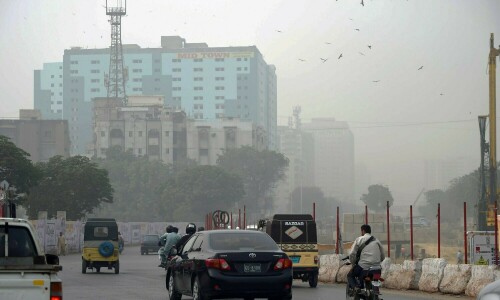
ISLAMABAD: The United Nations Environment Programme (UNEP) says the buildings and construction sector, already responsible for 37 per cent of global emissions and rising, with rapid urbanisation worldwide adding the buildings equivalent of a new Paris every five days.
The report, ‘Building materials and the climate: Constructing a new future’ released on Tuesday, a first-of-its-kind report developed by leading experts from six continents and designed to unite stakeholders from across the industry to cooperate on new pathways to radically accelerate the ethical decarbonisation of materials by 2050.
The report offers a three-pronged solution to reduce “embodied carbon” emissions and the negative impacts on natural ecosystems from the production and deployment of building materials such as cement, steel, aluminium, timber, and biomass.
The report suggests building less by repurposing existing buildings is the most valuable option, generating 50 to 70pc fewer emissions than new construction; promote construction with less materials and with materials that have a lower carbon footprint and facilitate reuse or recycle.
It called for a shift to ethically and sustainably sourced renewable bio-based building materials, including timber, bamboo and biomass.
The shift towards properly managed bio-based materials could lead to compounded emissions savings in many regions of up to 40pc in the sector by 2050.
The report called for improving decarbonisation of conventional materials that cannot be replaced. This mainly concerns the processing of concrete, steel, and aluminium — three sectors responsible for 23pc of overall global emissions today — as well as glass and bricks. Priorities should be placed on electrifying production with renewable energy sources, increasing the use of reused and recycled materials, and scaling innovative technologies.
Transformation of regional markets and building cultures is critical through building codes, certification, labelling, and the education of architects, engineers, and builders on circular practices, it says.
The report says the three-pronged ‘Avoid-Shift-Improve’ solution needs to be adopted throughout the building process to ensure emissions are slashed and human health and biodiverse ecosystems are protected.
The solution also requires, in its implementation, sensitivity to local cultures and climates, including the common perception of concrete and steel as modern materials of choice.
Buildings contain materials produced in disparate regions across the globe; reducing “embodied carbon” emissions from production and deployment of building materials therefore requires decision-makers to adopt a whole life-cycle approach.
This involves harmonised measures across multiple sectors and at each stage of the building lifecycle — from extraction to processing, installation, use, and demolition.
Most climate action was dedicated to reducing “operational carbon” emissions of buildings — heating, cooling, lighting, set to decrease from 75pc to 50pc of the sector in coming decades.
Climate action is needed to reduce “embodied carbon” emissions from production and deployment of building materials like cement, steel, and aluminium. To reach net zero emissions in the construction sector, future materials must be procured from renewable and reusable sources, points out the report.
Municipalities worldwide have recognised the benefits of integrating vegetated surfaces (green roofs and façades, indoor wall assemblies) to reduce urban carbon emissions and reclaim the benefits of nature lost through urbanisation: can generate up to 60pc energy savings compared with exposed concrete walls.
Mandating use of vegetated surfaces to cover exposed concrete or asphalt would help naturally keep buildings cool, reduce energy consumption, and absorb stormwater to reduce flooding, replenish water tables and urban biodiversity.
Published in Dawn, September 13th, 2023