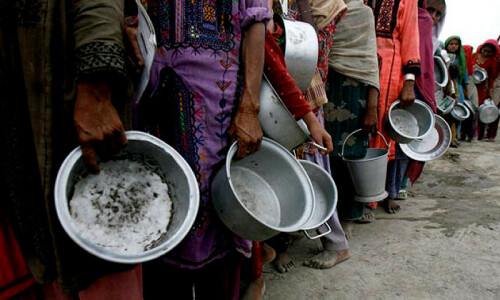
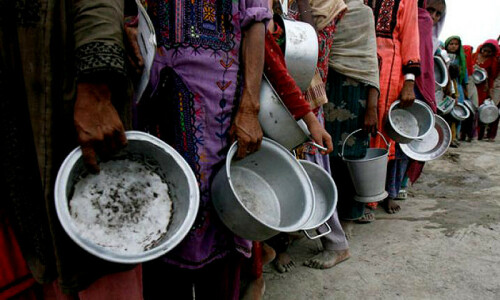
ISLAMABAD: The progress in terms of food and agriculture-related targets under the Sustainable Development Goals (SDGs) Agenda 2030 has stagnated or reversed, compounding the challenges in eradicating poverty and hunger, improving health and nutrition and combating climate change.
The Food and Agriculture Organisation (FAO) of the United Nations in its report ‘Tracking Progress on Food and Agriculture-related SDG Indicators 2023, released on Friday, says while the world was already off track from meeting the SDGs even before 2020, the past few years have seen multiple shocks that have further stalled or even reversed progress across several targets. These include the lingering effects of the Covid-19 pandemic, the impact of armed conflicts around the world, high inflation, along with escalating effects of the climate crisis.
The food and agriculture-related SDG indicators are in a particularly critical state. The proportion of the world population facing chronic hunger in 2022 was about 9.2 per cent compared to 7.9pc in 2015. The latest FAO estimates put the global hunger figure for 2022 between 691 million and 783 million people. Investment in agriculture has stalled, there is no progress in conserving animal genetic resources, and forest area across the globe continues to shrink.
Furthermore, food insecurity has increased significantly from 25.3pc of the global population in 2019 to 29.6pc in 2022. While the prevalence of severe food insecurity at the global level showed a marginal decline from 11.7pc in 2021 to 11.3pc in 2022, it remains far above pre-pandemic levels – equivalent to 180 million more people, compared to 2019.
Indicators focused on malnutrition present a mixed picture. Although stunting has declined from 26.3pc in 2012 to 22.3pc in 2022, the rate of reduction is not nearly close enough to meet the global target. In 2022, 6.8pc children under 5 years of age were affected by wasting, while the prevalence of overweight children, measured at 5.6pc, has stagnated in the past decade, requiring greater efforts towards the 2030 target.
While government spending on agriculture, one of main sources of investment in the sector, has increased in nominal terms, the agricultural orientation index has declined between 2015 and 2021. On the other hand, agricultural export subsidies, a source of market distortions, have declined consistently in the past two decades down to negligible levels in 2021. Published in Dawn, September 17th, 2023