Communications cut to Libya’s ruined city


DERNA: Telephone and internet links were severed on Tuesday to Libya’s flood-hit city of Derna, a day after hundreds protested there against local authorities they blamed for the thousands of deaths.
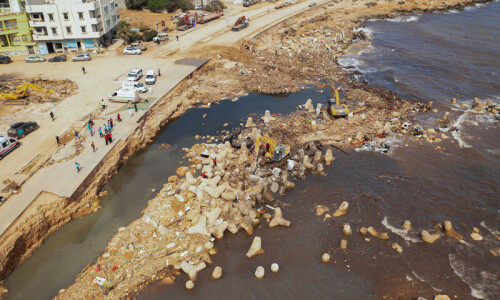
A tsunami-sized flash flood broke through two aging river dams upstream from the city on the night of September 10 and razed entire neighbourhoods, sweeping untold thousands into the Mediterranean Sea.
Protesters massed on Monday at the city’s grand mosque, venting their anger at local and regional authorities they blamed for failing to maintain the dams or to provide early warning of the disaster.
“Thieves and traitors must hang,” they shouted, before some protesters torched the house of the town’s unpopular mayor.
On Tuesday, phone and online links to Derna were severed, an outage the national telecom company LPTIC blamed on “a rupture in the optical fibre” link to Derna, in a statement on its Facebook page.
Climate change, conflict made floods more likely, says study
The telecom company said the outage, which also affected other areas in eastern Libya, “could be the result of a deliberate act of sabotage” and pledged that “our teams are working to repair it as quickly as possible”.
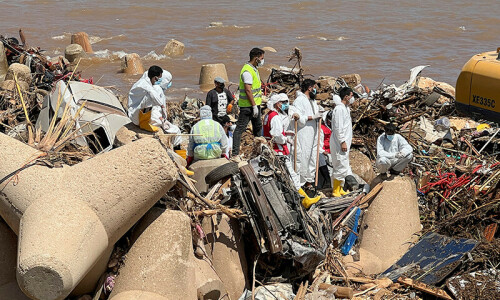
Rescue workers have kept digging for bodies, with the official death toll at around 3,300 but many thousands more missing since the flood sparked by torrential rains from Mediterranean Storm Daniel.
‘Humanitarian disaster’
Climate change made torrential rains that triggered deadly flooding in Libya up to 50 times more likely, new research said on Tuesday, noting that conflict and poor dam maintenance turned extreme weather into a humanitarian disaster.
Scientists from the World Weather Attribution group said a deluge of the magnitude seen in north-eastern Libya was an event that occurred once every 300-600 years. They found that the rains were both more likely and heavier as a result of human-caused global warming, with up to 50 per cent more rain during the period.
In a report looking at floods linked to Storm Daniel that swept across large parts of the Mediterranean in early September, they found that climate change made the heavy rainfall up to 10 times more likely in Greece, Bulgaria and Turkiye and up to 50 times more likely in Libya.
But researchers stressed that other factors, including conflict and poor dam maintenance, turned the “extreme weather into a humanitarian disaster”.
To unpick the potential role of global warming in amplifying extreme events, the WWA scientists use climate data and computer modelling to compare today’s climate — with roughly 1.2 degrees Celsius of heating since pre-industrial times — to that of the past. WWA scientists are normally able to give a more precise estimate of the role climate change has played — or its absence — in a given event.
But in this case they said the study was limited by a lack of observation weather station data, particularly in Libya, and because the events occurred over small areas.
Published in Dawn, September 20th, 2023