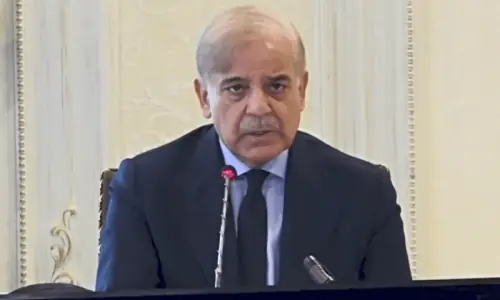
INTERIOR Minister Sarfraz Bugti has announced that all ‘illegal immigrants’ awaiting deportation from Pakistan to their respective countries will be put in ‘holding centres’. While briefing the media on Thursday, Mr Bugti ruled out an extension in the Oct 31 deadline for undocumented foreigners to leave, and shared the government’s ‘repatriation plan’ in the lead-up to the date. He gave assurances that the detainees will be provided medical facilities and food and that children, women and the elderly will be treated with “utmost respect”. He said the government will no longer ‘compromise’ on the issue, which the military has said is paramount for national security.
Mr Bugti’s briefing has raised several questions and concerns, not just about the logistics of implementing such a plan, but also about the unforeseen aspects of mass deportation. Firstly, let us address the logistics. According to international media reports, three such centres have been set up in KP, each capable of holding 5,000 people. As many holding facilities are being set up in Balochistan. This raises a fundamental question: how will such a massive number of individuals — of which Afghans alone number 1.7m according to Mr Bugti — be accommodated across the country? Are the facilities available adequate? Will the government provide clear and detailed plans for the practical execution of this policy or will we be left to imagine virtual concentration camps? State media is already referring to them as “detention centres”. Secondly, there is a pressing concern regarding the Oct 31 deadline for mass deportation. Such a swift and rigid timeline raises not just humanitarian concerns — as these pages have mentioned — but the sudden ejection of such a significant number of people might also have economic consequences. Many of these ‘illegal immigrants’ have likely, over the years, integrated into Pakistan’s workforce, contributing to various sectors. Their abrupt departure could create labour gaps and impact local businesses. Furthermore, the mass expulsion raises the likelihood of families being separated, inadequate access to legal processes, and the risk of leaving vulnerable individuals without support. It’s essential for the government to provide clarity on whether these individuals will have access to legal representation, especially if they contest their designation as ‘illegal’. A rushed and inhumane approach could have far-reaching consequences for the individuals involved and for Pakistan’s reputation on the global stage.
Published in Dawn, October 28th, 2023