The budget reflects a nation’s immediate and long-term fiscal priorities, serving as more than just an accounting document.
The current state of Pakistan’s budget suggests that it has become primarily an accounting representation, lacking comprehensive fiscal planning for both the present and the future. There is a prevalent misconception that post-election, all challenges will automatically resolve, and the economy will swiftly recover.
The central issue now revolves around how the new government plans to address the crises it has inherited. Furthermore, concerns have arisen about the capability and competence of state institutes in effectively managing these challenges.
On the other side, regrettably, none of the mainstream political parties appears adequately equipped or prepared to address Pakistan’s socio-economic issues. Instead of focusing on well-defined ideologies, these parties tend to prioritise shifting narratives, often centred on populist agendas. These changing narratives lack a stable foundation for sustainable economic growth.
Let us examine how the state can augment its revenue while concurrently curbing expenditures. On the revenue front, it is notable that Pakistan’s tax collection has diminished from 14 per cent of GDP in the 1980s to a mere 10pc in 2022.
This decline is compounded by the regressive nature of the existing tax structure, heavily reliant on indirect taxes. Specifically, a mere 33pc of taxes are sourced from income tax, primarily stemming from just eight million registered employees out of a workforce of 114m individuals.
Those employed in the informal sector remain largely undocumented. Moreover, inefficiencies in urban land taxation create distortions in various markets, coupled with the issue of lower taxation on plots, plot files, and parallel financial instruments, perpetuating informality and an unregulated economic environment in Pakistan, leading to a casino economy. The agriculture sector largely remains untaxed, with 90pc of farmers benefiting from tax exemptions for holdings up to 12.5 acres.
Decisive actions are needed to bring about substantial change, including the cessation of subsidies that primarily benefit the affluent
Likewise, the tax exemptions granted to various energy sector projects, real estate enterprises, and corporate entities primarily favoring the affluent, encompassing the corporate sector, influential landholders, the political elite, and the nation’s powerful military, cumulatively amount to an approximate $17.4bn billion, equivalent to roughly 6pc of the nation’s economic output.
By discontinuing these exemptions and concurrently broadening the tax base, the government possesses the potential to augment the tax-to-GDP ratio from its current 10.5pc to 13pc in the short term, with a trajectory toward reaching 18pc over the long run.
Expenditures in the current fiscal framework appear to lack coherence, accounting for a substantial 19.7pc of the GDP, while revenue generation lags at only 10.5pc of GDP. Notably, approximately 80pc of government spending is committed to predetermined categories, particularly a significant allocation for salaries, pensions, interest payments, and defence expenditures. A mere 2.5pc of GDP is earmarked for developmental initiatives.
Conversely, 1.8pc of GDP is allocated for subsidies, with over 80pc of these subsidies allocated to the energy sector, where a substantial 77pc accrues to the elite, upper-middle-class, and middle-class segments, primarily associated with higher electricity consumption.
In FY24, subsidies totalling Rs1.1 trillion are allocated in the budget. It is advisable to restrict subsidies to sectors directly benefiting the economically disadvantaged.
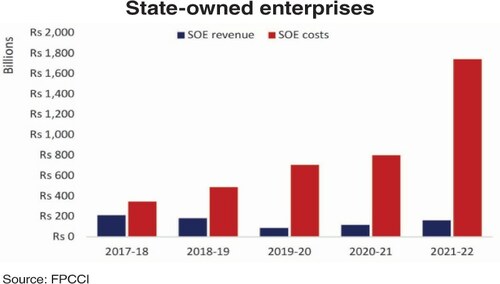
State-owned enterprises (SOEs) present a persistent fiscal challenge, with the top 14 SOEs registering losses of Rs458bn and accumulating circular debts that strain the national economy. Leveraging a private-public partnership approach and partial privatisation can enhance operational efficiency and reduce fiscal deficits.
The federal government, while holding substantial deposits of Rs2.02tr in banks, also remains indebted, with over 83pc of loans originating from government borrowing. This percentage could exceed 85pc with additional borrowing, as proposed in the current budget.
Efforts to counter inflation through a contractionary monetary policy have been hampered, largely due to the prevalence of cost-push inflation, stemming from rising business expenses such as energy costs, raw materials, and regulatory expenditures.
Elevated interest rates have further exacerbated operational costs, while high inflation has eroded purchasing power, contributing to a projected poverty rate of 37.2pc and a 38pc decline in purchasing power, driven by soaring food costs in 2023. Implementing the Treasury Single Account and phasing out subsidies has the potential to save over Rs850bn in the short term and more than Rs1.4tr in the long term.
The government should prioritise expanding the tax base instead of increasing tax rates. It is crucial to integrate individuals across income levels and the informal sector into the tax system. Additionally, the government should minimise discretionary spending.
Following the 2009 National Finance Commission Award, redundant federal agencies and organisations could be dissolved, and public sector entities facing deficits might be privatised or managed through public-private partnerships to enhance efficiency and reduce financial shortfalls. Moreover, the allocation of undue subsidies and tax incentives to specific interest groups should be restrained.
Neglecting to address this pivotal juncture has the potential to exacerbate poverty, deepen societal divisions, and impede the progress of the formal sector.
The current circumstances call for decisive actions to bring about substantial change, including the cessation of subsidies that primarily benefit the affluent, comprehensive tax reforms, the regularisation of the real estate market, and prudent expenditure reductions.
The writer is an Assistant Professor (PhD Financial Economics) at the National University of Modern Languages, Islamabad.
Email: abwahid.fms@gmail.com
Published in Dawn, The Business and Finance Weekly, November 6th, 2023