Pakistan and Israel are often understood by various political scientists and historians as nationalist twins. Membership to both is based on nothing but an idea of religious belonging. The Islam that Pakistan’s founders evoked to contextualise the creation of a ‘Muslim nation’ in India, and then a separate Muslim nation-state in South Asia, was not theological. It was an entirely modern construct.
Nationalism itself is a modern construct, not more than 350 years old. It seeks to unite the people of a territory as a national whole — a people who share a cultural, linguistic and geographical history. However, many of these histories too are inventions, shaped through imagined or exaggerated ‘memories’. But the ‘Muslim nationalism’ deployed by the founders of Pakistan was only loosely tied to a shared cultural history. It was more of an abstract idea of unity in a South Asian Muslim milieu that was ethnically diverse and highly sectarian and sub-sectarian.
Therefore, the invented nature of the Muslim nationalism that Pakistan’s founders shaped was a romantic idea of a Muslim ‘nation’ that was to look beyond its different ethnic identities within, and seek a separate Muslim homeland to avoid the expected political and cultural hegemony of India’s post-colonial Hindu majority.
Nationalism is inherently a secular idea that looks to unite a people on the basis of a historically shared territory or language. But India’s Muslims belonged to different ethnic formations — they belonged to differing sects and subsects, and spoke different languages. So, an overarching Muslim nationalism was invented, but one that could never have been theocratic because of the sectarian and ethnic differences within this ‘nation’.
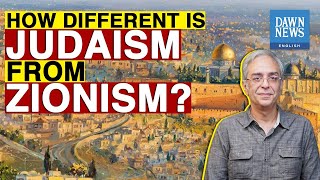
Much like the Muslim nationalism espoused by the founders of Pakistan, Zionism was also a modern and secular construct. And both were increasingly taken over by theocracy
Therefore, it was a secular formulation and the founders were conscious of this. This was something new in the evolution of the idea of nationalism though, wherein a religion was evoked to form a nation and then a nation-state. It used religion in a secular nationalist context (because a single language, race or ethnicity was missing). So an overarching and nationalist imagining of Islam became the main ingredient to formulate the creation of a modern nation-state.
In his 2013 book The Muslim Zion, the noted historian Faisal Devji wrote that the exceptionalism of the nationalism that was inherently secular but which gave birth to a ‘Muslim homeland’ in South Asia was very close to the idea that sought to create a modern Jewish homeland, Israel. The early ideologues of Zionism looked to establish a homeland for (mostly European) Jews who shared a history of persecution.
Like the Muslim nationalism of the founders of Pakistan, Zionism too was a modern construct. It was seeking to shape the Jewish people of different ethnic groups and races into a ‘nation’ with a homeland of their own. It too was secular, because of the diverse cultural and ethnic Jewish national whole that it was imagining.
So, Pakistan and Israel did emerge from what can be described as ‘religious nationalism’, but this nationalism was an extension of the inherently secular idea of nationalism. It did not seek to create a theocracy due to the ethnic, racial and sectarian diversity within the ‘nation’ that it was forming.
A year after the publication of Devji’s book, the historian Venkat Dhulipala published Creating a New Medina. In it, he argued that Pakistan was not created as a ‘Muslim Zion’ as such, or as a safe sanctuary for the Muslims of South Asia. According to Dhulipala, the country was imagined as a sovereign Islamic state, or “a new Medina.” It sought to trigger an Islamic revival and become the new leader of the ‘Muslim ummah’ and the successor to the fallen Turkish Caliphate.
Devji and another well-known historian, Ayesha Jalal, have been severely critical of Dhulipala’s thesis. Devji lambasted Dhulipala for constructing his thesis on obscure populist sources that did not have much say in the creation of the Muslim nationalism that gave birth to Pakistan. However, Dhulipala’s thesis was favourably received by various Islamist and Hindu nationalist groups in Pakistan and India.

What Dhulipala was suggesting was indeed present in the clutter of voices seeking a post-colonial arrangement in South Asia. But Devji is correct in pointing out that the voices expressing the desire to establish an Islamic state were nowhere to be found in the core nationalist circles that actually created the country. In fact, these voices were highly critical of these circles, accusing them of being secular and “token Muslims.”
But it is also a fact that the once-obscure and sidelined narrative of these voices did manage to replace the one formulated by the founders. This began to take place after Pakistan lost its eastern wing in a vicious civil war in 1971. Suddenly, the Muslim nationalism that had given birth to Pakistan began to be seen as a failure and was replaced with the narrative that Dhulipala explores in his book.
This is also why most post-1970s leaders, from Ziaul Haq all the way to Imran Khan, began to speak about creating Pakistan as a new Medina. This narrative also sits well with Islamist parties, and with Hindu nationalists in India. The latter rationalise their existence in opposition to the Islamic ‘other’.
Something similar happened to Zionism as well. But whereas the ‘Islamist’ strand of Muslim nationalism in Pakistan began to find traction after the country lost a war with India and a civil war in the erstwhile East Pakistan in 1971, a form of right-wing Political Judaism began to be added to Zionism after Israeli forces won a war in 1967 (against a combined Arab army).
In both cases, though, a sense of national insecurity and even paranoia played a major role. But in Pakistan, the Islamist dimension that was added to the country’s existential narrative has started to erode and is being vigorously questioned. On the other hand, the dimension of Political Judaism added to Zionism is witnessing a peak in Israel. For example, no other Israeli leader has used as much religious rhetoric and symbolism as the country’s current prime minister, Benjamin Netanyahu.
Indeed, the Islamist nationalism that deposed the more secular Muslim nationalism in Pakistan, and the right-wing ‘neo-Zionism’ that began to take shape in Israel, were both products of a heightened sense of existentialist paranoia. But gradually, Islamist nationalism as well as neo-Zionism became mere tools for authoritarian figures to safeguard their own political interests.
Another thing that neo-Zionists should bear in mind and/or learn from Pakistan is that, when the state begins to more aggressively mix religion with nationalism, this process often trickles down and generates non-state actors, who then begin to attack the state in their bid to create a theocracy. Can Zionism now be headed towards this peril?
Published in Dawn, EOS, November 19th, 2023