CLAD in her bridal attire, she was radiant with excitement. The air was filled with the loud, traditional rhythm of drums. Her friends were close by, whispering words of happiness about her new life.
It was the Mayun of R*, and she was on the cusp of starting a new chapter in her life. Her dream of marriage was almost a reality.
Or so she thought.
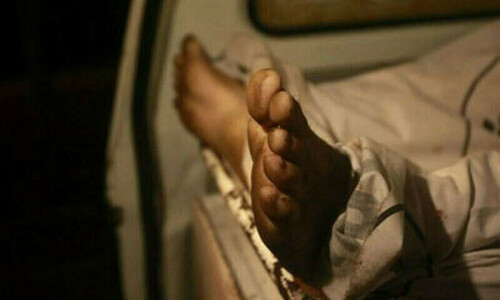
In a sudden, horrifying moment, the sound of gunfire pierced the air. R, surrounded by laughter and happiness moments ago, lay lifeless. Just a day before her marriage, she was no more. It was the end of a dream.
Her killing in Kohistan stemmed from the spread of a video on Facebook featuring her with a boy. A local jirga issued a hasty death decree without properly investigating the authenticity or the underlying motives behind the video.
In the neighbouring village, R’s friend, S*, was facing a similar death decree, as she was also featured in the video. However, S still had the luxury of being alive.
The wedding ceremonies of both brides-to-be were scheduled for Nov 25 and 26.
On Nov 24, R was tragically killed, leading the boys in the video and others to go into hiding.
The local police, accustomed to dealing with such cases, were quick to respond and took custody of both the deceased girl’s body and the other girl, whose life now hung in the balance.
However, S later told the Kolai-Palas magistrate that she believed her life was not in danger and that she would rather stay with her family than be sent to Darul Aman.
Despite being labelled as “stained” by her community, S faced the media, declaring that she had married her fiancé, who accepted her even after the controversial video emerged.
“Even when the gunshots took my friend’s life in the video, I wasn’t frightened,” she said. “I have never met the men shown with me and my late friend in that viral footage, as confirmed by my family and others on social media.”
This incident marked the first time the police actively addressed an “honour-related” case in Kolai-Palas (Kohistan), years after the spread of a video that resulted in the deaths of five women and four brothers of a man who was seen dancing in that video.
“We have treated this case as a red line and are committed to apprehending everyone involved in this murder or who played any part in it,” District Police Officer Mukhtar Khan Tanoli says.
He notes that because of the timely action — a rarity in such remote areas as Kohistan, the police were able to save one of the two girls whose lives were at risk.
The Federal Investigation Agency, which was engaged by the police to investigate the Facebook account involved in this case, also actively pursued the inquiry and promptly submitted its findings.
However, Mohammad Asif, the deputy director of the FIA’s cybercrime wing, explains that the Prevention of Electronic Crimes Act 2016 can’t be applied to this case, as the FIR already contains the provision of Section 302 of the Pakistan Penal Code.
He adds that police have also invoked Section 109 of the PPC, enabling them to pursue legal action against everyone directly or indirectly involved in this incident, from the person who uploaded the video on social media to the one who murdered the girl and those who aided the assailants.
“What was perceived as video is actually a series of edited pictures, combined and set to a local song for social media distribution,” Mr Asif says of the video that led to R’s death.
Aman Khan, also known as Mohammad Didar, one of the two boys seen in the footage, also told the media that he had never met either of the girls.
“Before being taken into protective custody by the police, I filed a complaint with the FIA’s cybercrime wing to seek action against those who uploaded the video and created a Facebook account in my name,” Aman says. “I suspect that people behind this conspiracy might also have a personal vendetta against me or the girls’ families.”
Kohistan — divided into the districts of Upper Kohistan, Lower Kohistan and Kolai-Palas — is a conservative and inaccessible area where several “honour killings” have been reported in recent years.
These killings are usually carried out by relatives who say they are acting in defence of their family’s honour.
R too was gunned down allegedly by her father and uncle.
*Names have been withheld to protect the identities of victims
Published in Dawn, December 2nd, 2023