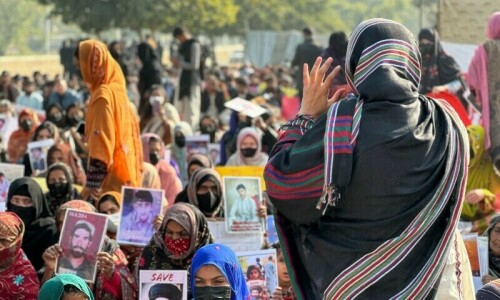
QUETTA: After conducting a month-long protest sit-in in Islamabad, the participants of the Turbat long march, led by Dr Mahrang Baloch, arrived in Quetta on Thursday. A crowd of thousands, including students and women, warmly welcomed the marchers at the Sariab area near Balochistan University.
Initially reaching the Hazar Ganji area on the outskirts of Quetta, the marchers later proceeded in a significant procession to the Balochistan University area, where a large crowd had gathered to receive them.
The protest march had originated in Turbat following the alleged extrajudicial killing of Balaach Mola Bakhsh, attributed to the Counter-Terrorism Department (CTD). The participants demanded the registration of an FIR against the officials involved.
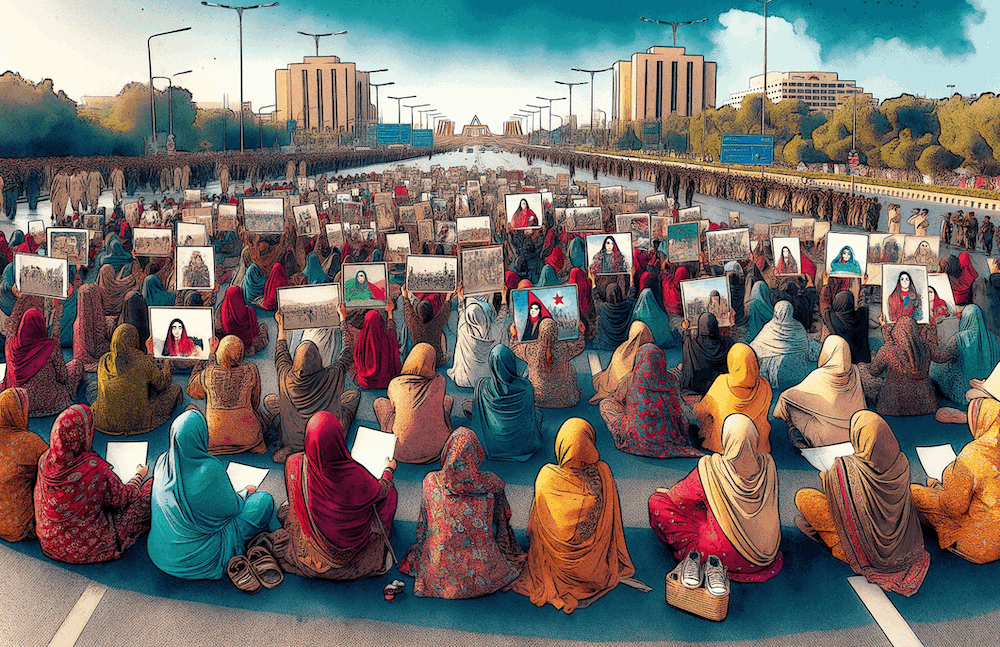
Starting their march from Turbat, the participants travelled through various areas, ultimately reaching Islamabad. There, they staged a sit-in in front of the National Press Club, advocating for an end to enforced disappearances of students, political workers, and human rights defenders.
Additionally, they called for the establishment of a judicial commission to investigate the killing of missing persons.
Activist denies Islamabad sit-in ended after negotiations with govt
“In Islamabad, the policemen pulled the veil (chadar) from the heads of our women and also tortured them,” Dr Baloch said, adding that the Baloch nation should never forget the heinous act, nor should they forget their missing brothers “who have been suffering torture in state prisons for many years”.
“We knew from the first day that we would not get justice from Islamabad; we had no expectations from Islamabad before and will not have any in the future,” she said.
Dr Baloch said that some government leaders are falsely claiming that they ended the sit-in through negotiations and clarified that the sit-in was not ended based on negotiations with anyone.
“If Baloch don’t wake up today, their condition will be worse than the Bengalis tomorrow,” she said.
She urged the public to join the gathering scheduled in Quetta on Jan 27, emphasising that the Baloch Yakjehti Committee (BYC) would unveil its next course of action during this public meeting.
The BYC, led by Dr Baloch, announced on Tuesday that pressures from the police and other state institutions, along with the indifferent attitude of government functionaries, had compelled them to call off the protest in Islamabad.
Dr Baloch spoke to the media while their belongings were being packed on Wednesday. She said the sit-in was to highlight the issue of missing persons in Balochistan, and their responsibility has been fulfilled.
“Now the people of Punjab who are educated and have a higher degree of awareness take up this responsibility to speak for the missing citizens of this country,” she said, adding that the BYC had become stronger after this protest and would continue its movement against enforced disappearances.
Right after BYC left the Islamabad campsite, Nawabzada Jamal Raisani, the leader of a rival camp set up by the Balochistan Shuhada Forum (BSF), announced that they were also winding up their camp as the key demand to establish a judicial commission had been met.
“I also had a meeting with the caretaker cabinet member Fawad Hassan Fawad and presented our demand to form a judicial commission, and we have been promised that the summary in this regard will be forwarded to the prime minister,” he said.
Additionally, Amnesty International has condemned the harassment faced by Baloch protesters in Islamabad.
In response, Caretaker Information Minister of Balochistan Jan Achakzai claimed that Amnesty International relied on “unverified claims, biased sources, and demonstrably false narratives” created by separatist elements with vested interests.
Published in Dawn, January 26th, 2024