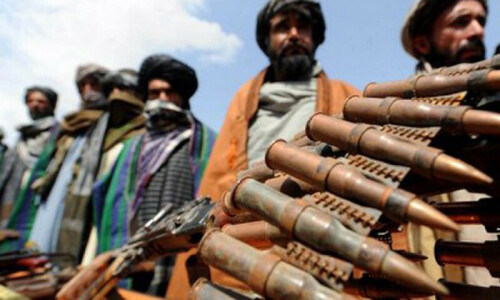
ISLAMABAD: The banned Tehreek-i-Taliban Pakistan (TTP) has been receiving “significant backing” from Al Qaeda and other militant factions for executing attacks in Pakistan in addition to support from the Afghan Taliban.
This was disclosed in the 33rd report submitted to the United Nations Security Council Committee by ISIL (aka Daesh) and Al Qaeda/Taliban Monitoring Team. The collaboration includes not just the provision of arms and equipment but also active on-ground support for the banned TTP’s operations against Pakistan.
Islamabad has repeatedly expressed its frustration over the Afghan Taliban’s inaction against the outlawed TTP, which has been responsible for numerous terrorist attacks within Pakistan.
Afghan Taliban’s failure to curb TTP’s activities has led to strained relations between the two countries. Pakistan views Kabul’s reluctance to tackle the TTP as a direct threat to its national security.
The report noted that despite the Afghan Taliban’s official stance discouraging TTP’s activities outside Afghanistan, many TTP fighters have engaged in cross-border attacks in Pakistan without facing any substantial repercussions. Citing reports, it said that some Taliban members, driven by a perceived religious duty, have joined TTP’s ranks, bolstering their operations.
Moreover, TTP members and their families are said to receive regular aid packages from the Afghan Taliban, signifying a deeper level of support.
The Afghan Taliban’s temporary imprisonment of between 70 and 200 TTP members and their strategy of moving personnel northward, away from the Afghanistan-Pakistan border regions, is perceived as an effort to alleviate Pakistani pressure to tackle the banned TTP activities.
In mid-2023, it recalled that the banned TTP established a new base in Khyber Pakhtunkhwa, where a large number of individuals were trained as suicide bombers. Additionally, Al Qaeda core and Al Qaeda in the subcontinent have been instrumental in providing training, ideological guidance, and support to the outlawed TTP, illustrating the intertwined nature of these militant networks.
Reported orders from Al Qaeda to allocate resources to the banned TTP indicated a deep-rooted collaboration aimed at destabilising the region.
Furthermore, the formation of TJP (Tehreek-i-Jihad Pakistan) as a front to provide the outlawed TTP with plausible deniability, and the involvement of other groups like ETIM/TIP (East Turkestan Islamic Movement/Turkestan Islamic Party) and Majeed Brigade in joint operations with TTP, underscore the multifaceted and transnational threat posed by these militant alliances.
The report pointed out that the East Turkestan Islamic Movement/Turkestan Islamic Party (ETIM/TIP) has shifted its base from Badakhshan Province to Baghlan Province, expanding its operational reach across various regions.
The group, it said, is intensively engaged in training the youth for its reserve forces and is notably enhancing the recruitment and training of women.
Concerns, it said, were mounting among regional countries due to ETIM/TIP’s active collaboration in recruitment, training, and strategic planning with other extremist groups, particularly the banned TTP, posing a significant security threat to the area.
Reports from an unnamed member state highlighted that Al Qaida’s core faction was significantly contributing to ETIM/TIP by offering both training and ideological mentorship.
Meanwhile, the Majeed Brigade, engaged in insurgency in Balochistan, is reported to have a strength of around 60 to 80 combatants, with a strategic focus on “recruiting female suicide bombers”.
It’s known for its collaboration with the outlawed TTP and ISIL-K in various domains, including training, arms procurement, intelligence exchange, and coordinated operations, although more details are being sought by some member states.
The Brigade has claimed responsibility for multiple attacks targeting law enforcement and Chinese personnel in Pakistan.
Published in Dawn, February 1st, 2024