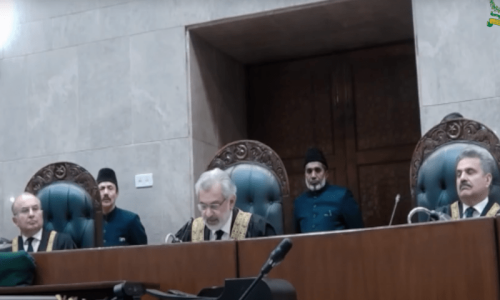
ISLAMABAD: Chief Justice of Pakistan (CJP) Qazi Faez Isa on Monday said judges do not have the ability to adjudicate on indeterminate matters of morality, nor were able to bifurcate morality from immorality, virtue from vice, and then proceed to meticulously weigh them.
Human characteristics and qualities seldom remain static; they change even during the course of a single day, the CJP observed.
These observations came in a detailed judgement written to explain why, on Jan 8, 2024, it scrapped its 2018 judgement by a majority of six to one, which had permanently shut the doors of parliament for lawmakers disqualified under Article 62(1)(f) of the Constitution for not being “honest and righteous”.
The majority judgement had explained that the interpretation of Article 62(1)(f) slapping a life ban — as taken in the 2018 Samiullah Baloch case — was beyond the scope of the article itself since the provision was not self-executory.
Justice Mansoor’s note points out lack of specification for court in Article 62(1)(f) declarations
Then the seven-judge bench had taken up a number of appeals moved by the appellants who were disqualified from contesting the elections or their nomination papers were rejected.
Now, in the detailed verdict, the CJP observed that only once a life has been lived out and death has intervened can an opinion be expressed with some certainty, and then too only to the extent of what was publicly known about a person.
The good character of an intensely private altruist will be just as unknown as the bad character of an undetected criminal, the CJP said, adding that if someone devoid of the virtues and qualities of Article 62(1)(d), (e), and (f) may also come to acquire them or possessing them proceed to lose them. And who adjudicates would also matter; one judge may consider that someone is of good character, but another may have the opposite opinion.
Matters mentioned in clauses (d), (e), and (f) of Article 62(1) are inherently subjective and may also change, the CJP observed, adding that earthly judges should adjudicate on matters that are discernible, determinable, and clearly expounded by the law, avoiding the domain of heaven.
The decision in the Samiullah Baloch case did not consider that Article 62(1)(f) does not specify the court of law required to make the declaration, does not provide the procedure for making the declaration, and does not specify the period for which the disqualification is incurred, the judgement said. Whether clauses (d), (e), and (f) of Article 62(1) were merely aspirational was also not considered.
Courts of law deal with tangible concepts, and if a law or a constitutional provision is vague, it has to be interpreted as per well-established rules of construction, in favour of the citizen. Courts should crystallise ambiguities and avoid leaning into them, the CJP explained.
If the Constitution leaves a matter indeterminate or vague it does not mean that jurisdiction and authority has been conferred upon the courts. Moreover, in the absence of an objective standard, judges would be left to decide cases as per their individual preferences and varying perceptions of morality.
Allowing this would be destructive of a clearly defined constitutional and legal order in which the fundamental rights of fair trial and due process, stipulated in Article 10A of the Constitution, would stand negated. Applying different standards would also negate equal treatment, as mandated by Article 25(1) of the Constitution, the judgement explained.
Additional note
Meanwhile, Justice Syed Mansoor Ali Shah, in an additional note, observed that neither the Constitution nor any law specifies the court of law competent to make the declaration mentioned in Article 62(1)(f) and provides for the manner and procedure of making such declaration.
The decision given in the Sami Ullah Baloch case that the declaration made by a court of civil jurisdiction regarding breach of certain civil rights and obligations is a declaration mentioned in Article 62(1)(f) and that such declaration has a lifelong disqualifying effect, is not based on any constitutional or statutory provision but rather amounts to legislating and reading into the Constitution, thus ‘plainly and palpably wrong’.
Thus, with great respect to the learned judges who rendered the decision in the Samiullah Baloch case, we hold that the statement of law made therein is not correct and is therefore overruled, Justice Shah observed.
Published in Dawn, February 20th, 2024