• PML-N chief enjoys support of 205 MNAs, needs 169 votes to defeat Omar Ayub
• PTI-backed MNAs in no mood to cease anti-rigging protests in NA
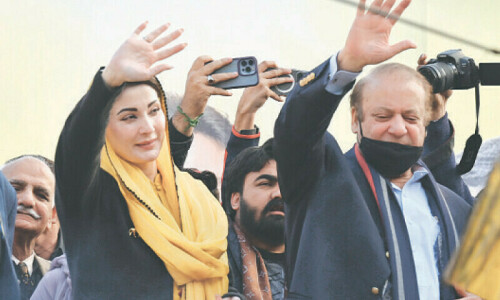
ISLAMABAD: PML-N President Shehbaz Sharif, who is the joint candidate of the newly-formed eight-party alliance, looks poised to win the election for prime minister for the second time, as he faces PTI-nominated Omar Ayub Khan in the contest scheduled to be held in the newly-constituted National Assembly on Sunday (today).
Both candidates submitted their nomination papers to the National Assembly Secretariat, which were declared valid by Speaker Ayaz Sadiq after the scrutiny, conducted in the presence of the leaders from both sides.
According to the National Assembly Secretariat, eight nomination papers had been submitted by Mr Sharif whereas four papers were submitted by Mr Khan carrying the signatures of different proposers and seconders.
Omar Ayub had raised an objection against Shehbaz Sharif, saying the PML-N leader was ‘gifted’ his NA seat through manipulation in Form-47. He said the lawmaker could not contest the PM election because he had lost the constituency as per Form-45. He has been wrongly administered the oath as MNA and thus cannot be a candidate for the prime minister’s position, Mr Ayub said in a tweet. The objection was rejected.
After getting the offices of the speaker and the deputy speaker in nearly one-sided contests on Friday, the newly-formed alliance seems confident to win the office of the country’s chief executive whereas the PTI lawmakers, who had been elected as independents and later joined the Sunni Ittehad Council (SIC), are expected to continue their noisy protest in the house over the alleged rigging in the Feb 8 elections.
Besides the PML-N, Mr Sharif has the backing of the PPP, MQM-P, PML-Q, BAP, PML-Z, IPP, and the NP having a total of 205 members. Two MNAs-elect from the MQM-P and PPP have yet to take oath. In order to become the leader of the house, Mr Sharif requires 169 votes in the 336-member house.
On the other hand, the PTI-backed opposition has 102 lawmakers, out of which one member has not taken the oath. Meanwhile, the JUI-F and BNP-Mengal are likely to boycott the poll.
At present, 304 lawmakers have taken oath whereas the ECP has so far withheld the notification of 23 reserved seats for women and minorities.
On Friday, Mr Sadiq of PML-N won the speaker’s election after securing 199 votes against his rival Amir Dogar of PTI, who secured 91 votes in the house.
The elections of the speaker and deputy speaker were conducted through a secret ballot amid protests by PTI lawmakers who declared it “unconstitutional” saying the house was incomplete without allocation of reserved seats.
The eight JUI-F members and BNP-M chief Akhtar Mengal, who had boycotted the elections for the speaker and the deputy speaker, have not made any categorical announcement about their participation in the Sunday’s election.
However, the Maulana flew to Karachi on Saturday night, indicating he would not be in the assembly for the PM’s poll.
The election will be conducted in the NA under Article 91 of the Constitution.
Article 91(3) says: “After the election of the speaker and the deputy speaker, the National Assembly shall to the exclusion of any other business, proceed to elect without debate one of its Muslim members to be the prime minister.”
“The prime minister shall be elected by the votes of the majority of the total membership of the National Assembly: provided that, if no member secures such majority in the first poll, a second poll shall be held between the members who secure the two highest numbers of votes in the first poll and the member who secures a majority of votes of the members present and voting shall be declared to have been elected as prime minister,” reads Article91(4) of the Constitution.
The procedure for the election, however, has been given in Chapter IV and Second Schedule of the Rules and Procedure for the Conduct of Business in the National Assembly 2007.
“Before voting commences, the speaker shall direct that the bells be rung for five minutes to enable members not present in the chamber to be present. Immediately after the bells stop ringing, all the entrances to the lobby shall be locked and the assembly staff posted at each entrance shall not allow any entry or exit through those entrances until the voting has concluded,” according to the Second Schedule.
The speaker shall then ask the members who wish to vote in favour of the candidates to go to the allocated lobbies through the entrance where tellers shall be posted to record the votes.
On reaching the desk of the tellers, each member shall, in turn, call out the division number allotted to them under the rules. The tellers shall then mark off the number on the division list simultaneously calling out the name of the member.
In order to ensure that his vote has been properly recorded, the member shall not move off until they have clearly heard the teller call out their name. After a member has recorded his vote, they shall not return to the chamber until bells are rung.
When the speaker finds that all the members who wished to vote have recorded their votes, he shall announce that the voting has concluded. Thereupon the secretary shall cause the division list to be collected, count the recorded votes, and present the result of the count to the speaker.
The speaker shall then direct that the bells be rung for two minutes to enable the members to return to the chamber. After the bells stop ringing, the speaker shall announce the result to the assembly.
Published in Dawn, March 3rd, 2024