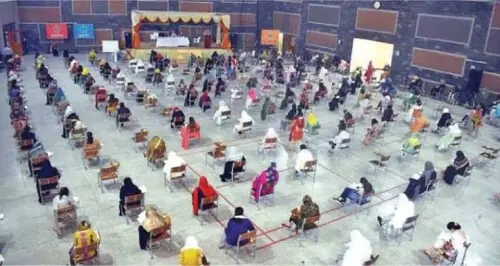
KARACHI: Women politicians and activists have been subjected to victimisation and harassment since the inception of the country and the prime reason behind this aberration is mixing religion with state affairs, claimed lawyers and rights activists at a seminar held here on Wednesday.
The seminar, titled ‘Political victimisation and harassment of women in politics’, was organised by the Shaheed Zulfikar Ali Bhutto Institute of Science and Technology (Szabist).
Speaking on the occasion, rights activist and member of Women’s Action Forum Anis Haroon said women were being subjected to political victimisation even in assemblies where they had to face hostile and intolerant environment.
Sharing a recent example, she said that cases against PTI chief Imran Khan were mentioned during a session of the Khyber Pakhtunkhwa Assembly where PML-N MPA Sobia Shahid just took off her wrist watch and waved it in the air in the assembly without saying anything (in a reference to Mr Khan’s Toshakhana case).
Women are facing victimisation since inception of the country, seminar told
Ms Haroon added that there were many ways to respond to that gesture in a civilised manner. However, the assembly members surrounded the MPA and started harassing her.
Ms Haroon said that did not happen to a woman who lived in some village and did not know about her rights, but rather a woman who was representing thousands of other women in an assembly.
“This is the level of our assemblies and the people sitting there,” she said. “All of this is very painful for us.”
She said there was no civility even in the country’s assemblies about use of language, let alone the outside world.
She said suppression of women started to increase during Gen Zia’s era, which gradually increased in the country.
Women were fighting for their rights for years in the country and had made many achievements, but there was still a long way to go, she added.
Lawyer Sarah Malkani spoke about the recent Iddat case, which had angered the people throughout the country.
She said she along with many other lawyers also did not support the judgement of the court against Mr Khan’s wife.
She added that there was also a confusion in Pakistan’s family laws.
Women’s Action Forum had been demanding since 1950s that family laws were codified and proper legislation was made in this regard, especially in matters related to marriage, divorce, custody, guardianship, inheritance, etc, she added.
The laws had been codified to some extent in 1961 under the Muslim Family Law Ordinance, but during the ‘Islamisation’ of the country in General Zia’s era, new laws were enforced and courts started to ‘misinterpret’ the provisions passed earlier.
All that weakened the Muslim Family Law Ordinance, she added.
“So there is still a confusion over these matters,” she said, adding that people and families were suffering from that confusion and taking advantage of that confusion, Imran Khan and his wife had been politically victimised. “But I hope that the superior courts will clarify this problem”, she said.
PPP MPA Sadia Javed said political victimisation of women had been happening since early years of Pakistan, starting from Fatima Jinnah.
And then Gen Zia’s period was the darkest part of the country’s history for women as many of them were victimised in that period, especially Nusrat Bhutto and Benazir Bhutto as well as other women in bureaucracy, the MPA added.
When Benazir Bhutto became the prime minister, people spoke against her and criticised her because she was a woman. Likewise, many inappropriate things were being said against Punjab Chief Minister Maryam Nawaz, she said.
Sadia Javed said women also faced issues in courts for khula matters and cases of children’s custody.
“So if we [women] do not unite, we cannot win this war,” she added.
Dean of faculty of social sciences Szabist Dr Riaz Sheikh said the issues of women’s victimisation and harassment should be seen and discussed as part of a larger picture and discourse.
Incidents at educational institutes and other places in society should also be taken into consideration in this regard, he added.
He said women had been made more vulnerable in the country and their subjugation and suppression was mainly because of mixing religion with the state affairs.
There was a need to make a society that was free of caste, creed, religion and gender discrimination, the dean concluded.
Published in Dawn, March 21st, 2024