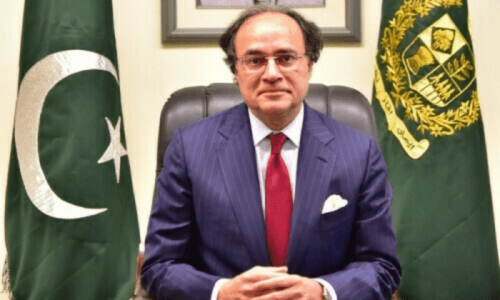
Don’t need more policy prescriptions, says Finance Minister Aurangzeb


WASHINGTON: Finance Minister Muhammad Aurangzeb said on Monday that Pakistan doesn’t need too many policy prescriptions, it just needs to implement those policies.
Speaking at the Atlantic Council think tank on his first working day in Washington, the minister also urged institutions such as the World Bank and International Monetary Fund (IMF) to help countries like Pakistan deal with the effects of climate change and achieve financial inclusivity.
The minister, who is in the US to attend the spring meetings of the World Bank group and discuss a new loan package with the IMF, stressed the need for promoting financial inclusiveness and climate resilience when asked to comment on the ongoing debate about reforming the two financial institutions.
The minister pointed out that Pakistan was not a major emitter, yet it was among the major victims of climate change. The country also needed financial inclusion to enhance the position of women in the national economy, he noted.
On his first day in Washington, finance minister seeks help with tackling climate change fallout
Mr Aurangzeb made it clear in the very beginning that during his almost week-long stay in Washington, he would seek a new programme from the IMF.
Responding to another question, he said Pakistan was looking for a larger and longer program from the IMF because “we need two to three years for structural reforms.”
He said he would like to conclude the formalities and get a new Extended Fund Facility (EFF) package from the IMF “as soon as we can, but these are just preliminary discussions”.
He said that during his negotiations with the Fund’s team in Islamabad, he learned that the IMF believed Pakistan had the capability, but it needed to carry out the reforms it pledged. “The PM is quite keen and vocal on the need for a new programme,” he added.
If the this week’s discussions are fruitful, Pakistan anticipates an IMF mission visiting Islamabad next month for further talks on the loan. Additionally, the delegation plans to negotiate increased financing with the World Bank.
Pakistan is also eagerly anticipating the release of $1.1bn under the current Stand-By Arrangement (SBA) expiring this month.
Talking about the need to expand the tax base and reform the system of tax collection, the minister said the reforms would not only increase the revenue but also bring transparency and improve the client experience.
He also emphasized the need to encourage public-private partnership, pointing out that the government couldn’t do everything.
Pakistan, he said, needed “timely decisions, timely execution” to build its economy as “no strategy works without execution.”
Asked how Pakistan could successfully rebuild its economy, the minister said: “We do not need too many policy prescriptions. We know what to do … it’s time for us to start moving”.
Business council
Earlier, the finance minister commenced his official engagements by meeting a delegation from the US-Pakistan Business Council. During the meeting, the minister highlighted the government’s dedication to attracting both foreign and domestic investments in key sectors, a press statement said. These sectors include agriculture, IT, mines & minerals, and energy.
He also met Mohamed Nasheed, former president of the Maldives and the current head of the Climate Vulnerable Forum.
“He highlighted Pakistan’s vulnerability to climate change, the role played by the country in the establishment of Loss and Damages Fund and the way forward to address climate challenges in vulnerable countries,” said a statement issued by Mr Aurangzeb’s team.
Published in Dawn, April 16th, 2024