Aurangzeb pledges aggressive reforms at IMF meeting


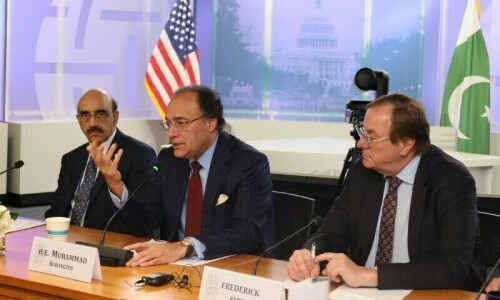
WASHINGTON: In a meeting with the IMF chief and some members of its board of governors, Finance Minister Muhammad Aurangzeb has reaffirmed Pakistan’s resolve to carry out “aggressive reforms” to stabilise its economy.
These discussions were part of a meeting of Middle East and North Africa (MENAP) ministers and governors with IMF Managing Director Kristalina Georgieva held on Tuesday.
Mr Aurangzeb “underscored aggressive reforms, including broadening the tax net, privatising loss-making SOEs, expanding social safety nets and facilitating the private sector,” his team said in a statement issued a day after the meeting.
The minister underscored the implications of geo-economic fragmentation on Pakistan and expressed gratitude to the IMF, multilateral development banks, and “time-tested sincere bilateral partners” for their unwavering support during these trying times.
He stressed the significance of reallocating a nation’s special drawing rights (SDRs) within the IMF to tackle economic hurdles effectively. Additionally, he highlighted the necessity of reassessing surcharge policies and giving precedence to the IMF’s Resilience and Sustainability Trust (RST) to address climate vulnerabilities.
Assures lender of broadening tax net, privatising SOEs, expanding social safety nets, facilitating private sector
The IMF’s Resilience and Sustainability Trust (RST) has been in operation for more than a year, with the initial 17 countries securing commitments of financial assistance. Pakistan, identified as a low emitter yet severely impacted by climate change, is also seeking aid from this fund.
Advocating for a more proactive and responsive Global Financial Safety Net to address heightened risks, the minister applauded the IMF’s renewed focus on Capacity Building through Regional Capacity Development Centres (RCDCs).
The minister advocated for a proactive global financial safety net to address heightened risks and appreciated the IMF’s renewed emphasis on capacity-building through regional capacity development centres. He also stressed the importance of collaborative efforts for sustainable economic development.
Pakistan, in pursuit of another long-term package — its 24th thus far — from the IMF, has formulated a comprehensive economic recovery plan. This plan encompasses three primary components: taxation, energy, and streamlining the privatisation of state-owned enterprises (SOEs), including PIA.
The IMF board is scheduled to convene on April 29 to deliberate on releasing the final tranche of its current programme with Pakistan. Subsequently, discussions between IMF staff and Islamabad regarding the new package are anticipated to commence.
During Tuesday’s meeting, the IMF acknowledged Pakistan’s progress in meeting its conditions, while Pakistani officials advocated for a new plan tailored more specifically to Pakistan’s needs.
Later, at a JP Morgan Seminar on Pakistan’s Economic Policy Outlook, Mr Aurangzeb emphasised positive economic indicators such as the robust performance of the agriculture sector, decreasing inflationary pressures, a stable exchange rate, shrinking trade deficit, and robust remittance inflows.
He informed the participants that Pakistan was committed to engaging in a broader and extended programme with the IMF.
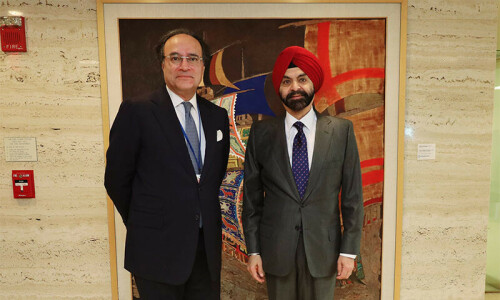
At a meeting with Ajay Banga, president of the World Bank Group, the minister emphasised Pakistan’s advancements under the nine-month SBA programme and the ongoing reforms in key sectors such as taxation, energy and privatisation.
Both parties acknowledged the necessity of establishing a 10-year rolling Country Framework Plan.
The World Bank president pledged his complete support for Pakistan’s reform initiatives and digitalisation efforts aimed at stabilising the economy and boosting revenues. Additionally, the minister extended an invitation for the president to visit Pakistan.
Published in Dawn, April 18th, 2024