• South Sudan closed its schools to 2.2m students in March
• Thousands of schools in Philippines, India shut in April
• 17pc of children already out of school
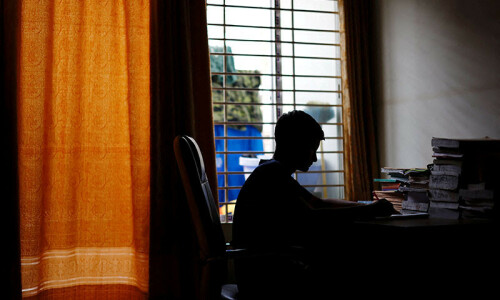
DHAKA: Hena Khan, a grade nine student in Dhaka, has struggled to focus on her studies this week as temperatures surpassed 43 degrees Celsius (109 degrees Fahrenheit) in the Bangladesh capital.
“There is no real education in schools in this punishing heat,” she said. “Teachers can’t teach, students can’t concentrate. Rather, our lives are at risk.”
Hena Khan is one of more than 40 million students who have been shut out of classrooms in recent weeks as heatwaves have forced school closures in parts of Asia and North Africa.
Bangladesh’s weather bureau said on Wednesday that last month was the hottest April on record, with the South Asian nation and much of the region still enduring a suffocating heatwave.
“This year the heatwave covered around 80 per cent of the country. We’ve not seen such unbroken and expansive heatwaves before,” Bangladesh Meteorological Department senior forecaster Muhammad Abul Kalam Mallik told AFP.
He said last month was the hottest April in Bangladesh since records began in 1948 “in terms of hot days and area coverage in the country”.
As the climate warms due to the burning of fossil fuels, heatwaves are lasting longer and reaching greater peaks.
In turn, government authorities and public health experts across the world are increasingly grappling with whether to keep students learning in hot classrooms, or encourage them to stay home and keep cool.
Either decision has consequences. About 17pc of the world’s school-aged children are already out of school, according to United Nations data, but the proportion is much larger in developing countries with nearly a third of sub-Saharan Africa’s children out of school compared to just 3pc in North America.
Child test scores in the developing world also lag developed countries.
Heat could exacerbate inequalities, widening learning gaps between developing nations in the tropics and developed countries, experts told Reuters, and even between rich and poor districts in wealthy countries. But sending children to overheated schools could make them ill.
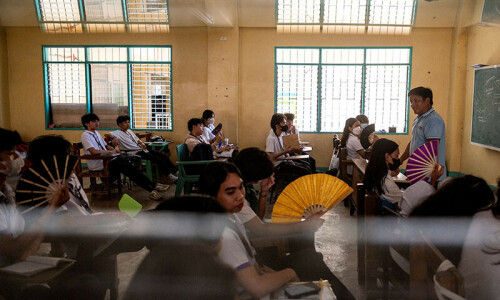
South Sudan already this year closed its schools to some 2.2 million students in late March when temperatures soared to 45 degrees Celsius. Thousands of schools in the Philippines and in India followed suit in late April, closing classrooms to more than 10 million students.
On Wednesday, Cambodia ordered all public schools to slash two hours off the school day due to avoid peak heat at midday.
Meanwhile, Bangladesh has wavered between opening and closing schools for some 33 million students amid pressure to prepare pupils for exams even as temperatures climb to dangerous levels.
Many Bangladeshi schools “don’t have fans, the ventilation is not good, and they might have tin roofing which does not provide good insulation”, said Shumon Sengupta, Bangladesh country director for nonprofit Save the Children.
In Bangladesh last year, schools were closed for 6-7 days, said Save the Children’s Sengupta. “But this year, they are saying it might be closed for 3 to 4 weeks,” he said, as May is often the hottest month in South Asia.
Hot heads
Even if students continue attending classes during heatwaves, their education is likely to suffer.
High temperatures slow down the brain’s cognitive functions, lowering pupils’ ability to retain and process information. US high schoolers, one 2020 study found, performed worse on standardised tests if they were exposed to higher temperatures in the year leading up to the exam.
The research, published in the American Economic Journal, found that a 0.55C (1F) warmer school year reduced that year’s learning by 1pc. Much of that impact disappeared in schools that had air conditioning, said study co-author Josh Goodman, an economist at Boston University.
Between 40pc and 60pc of US schools are thought to have at least partial air conditioning, according to various surveys. Schools without it are often found in poorer districts which already trail their wealthier counterparts academically.
Published in Dawn, May 2nd, 2024