Webb telescope finds most distant galaxy ever observed, again


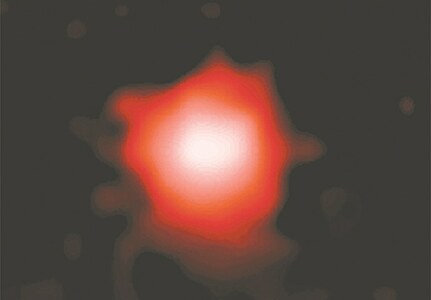
WASHINGTON: The James Webb Space Telescope has discovered what appears to be a new record-holder for the most distant known galaxy, a remarkably bright star system that existed just 290 million years after the Big Bang, Nasa said on Thursday.
Since coming online in 2022, the Webb telescope has ushered in a new era of scientific breakthroughs, peering farther than ever before into the universe’s distant reaches — which also means it is looking back in time. And the latest finding has “profound implications” for our understanding of the so-called Cosmic Dawn, researchers said.
An international team of astronomers first spotted the galaxy called JADES-GS-z14-0 in early 2023, but they needed further observations to be sure it really was a record-breaker rather than a “confounding oddball,” they said in a joint statement.
“The source was surprisingly bright, which we wouldn’t expect for such a distant galaxy, and it was very close to another galaxy such that the two appeared to be part of one larger object, said Stefano Carniani from Scuola Normale Superiore in Italy and Kevin Hainline from the University of Arizona.
By the time light from the most distant galaxies reaches Earth, it has been stretched by the expansion of the universe and shifted to the infrared region of the light spectrum, which Webb is equipped to detect with unprecedented clarity. The team carried out two confirmatory observations in October and then January — first with Webb’s primary imager called NIRCam, and second with its NIRSpec that analyses the light from an object to determine its physical properties — to be more certain of their hypothesis.
Not only does the new finding comfortably beat the previous record for oldest known galaxy — which was held by JADES-GS-z13-0 that was present 320 million years after the Big Bang — it also raises intriguing new questions for astronomy.
“The most important aspect of JADES-GS-z14-0 was that at this distance, we know that this galaxy must be intrinsically very luminous,” said Carniani and Hainline. From the images, the galaxy was determined to be 1,600 light years across, suggesting that the light is coming from mostly young stars and not from emission near a growing supermassive black hole.
“This starlight implies that the galaxy is several hundreds of millions of times the mass of the Sun!” said the researchers.
Taken together, the observations of JADES-GS-z14-0 upend astronomical predictions of what the earliest galaxies may have looked like following the Big Bang 13.8 billion years ago.
Published in Dawn, May 31st, 2024