KARACHI: The prospects of success for Pakistan’s economic reforms under the International Monetary Fund (IMF) programme remain tenuous, with significant challenges ahead for the government and economy, opine business leaders.
Earlier this month, Pakistan and the IMF reached a Staff-Level Agreement (SLA) for a $7 billion Extended Fund Facility.
The IMF-mandated reforms included increases in tax revenues to 1.5 per cent of GDP in FY25 and 3pc over the 37-month programme. “Revenue collections will be supported by simpler and fairer direct and indirect taxation, including by bringing net income from the retail, export, and agriculture sectors properly into the tax system,” IMF’s statement said.
The reform programme is front-loaded, setting quarterly tax revenue targets based on the Federal Board of Revenue’s (FBR) capacity to collect, explains Ehsan Malik, CEO of the Pakistan Business Council (PBC). The success of these targets depends on cash flows, including refundable taxes, which complicates meeting revenue expectations.
“The government has set an ambitious 40pc higher tax target while increasing expenditure by over 20pc. This imbalance is likely to result in a higher-than-expected budget deficit, necessitating further borrowing, fuelling inflation, and preventing a reduction in the monetary policy rate,” he predicts.
PBC chief believes ambitious tax target with higher expenditure will steepen budget deficit
Mr Malik expects that the government won’t meet its targets. It may secure one tranche but will struggle to secure the next, leading to a scramble for higher tax funds via a mini-budget that will further tax already squeezed taxpayers.
Commenting on the approach to reforming the electricity sector through tariff hikes, Mr Malik argues that without addressing fundamental issues such as excess capacity, transmission and distribution (T&D) losses, and the recovery performance of distribution companies (Discos), circular debt will continue to be a problem. “Incremental tariff increases alone will not suffice to stabilise the sector,” he says.
The political economy context further complicates the implementation of these reforms. Mr Malik highlights that the government’s fragile position undermines the stability necessary for sustained economic reforms. Recently, global rating agency Fitch forecast that the PMLN-led coalition government would remain in office for 18 months rather than completing its five-year tenure.
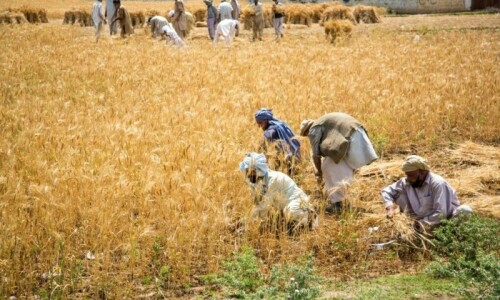
A precarious government is unlikely to push through unpopular measures such as imposing agricultural taxes, which are likely to be postponed despite provincial agreements. Regarding the new taxes implemented along the manufacturing value-added chain, Mr Mailk said that the end result would likely be inflationary, preventing deeper cuts into the monetary policy rate.
Former finance minister Miftah Ismail echoed Mr Malik’s pessimism. “The budget was not about reforms,” he says, scoffing at the idea that the government will be able to reach the tax-collecting authority’s targets.
Earlier this month, FBR Chairman Malik Amjad Zubair Tiwana said that neither the Rs13 trillion tax target nor Prime Minister Shehbaz Sharif’s initiative for the complete digitisation of the FBR would be realised soon while speaking at a National Assembly Standing Committee on Finance meeting.
“If the targets are not met, the government might have to come up with a mini-budget for another round of taxes, possibly around January,” Mr Ismail hypothesised. The government has decided not to tax large agricultural landowners or shops or to discuss the National Finance Commission Award while continuing to hand out large amounts to the provinces and increasing government spending, the former finance minister said while critiquing the budget.
M. Abdul Aleem, Secretary General of the Overseas Investors Chamber of Commerce and Industry (OICCI), acknowledged the task ahead for the FBR, stating it is still too early to take a definitive position. While he did not comment on the feasibility of a mini-budget, he noted that the FBR’s targets are steep and challenging despite their efforts.
Published in Dawn, July 25th, 2024