The decision to ban the opposition Jamaat-i-Islami (JI) party was “long overdue”, Bangladesh’s Law Minister Anisul Huq told Anadolu on Friday.
The government had issued on Thursday a circular under the Anti-Terrorism Act of 2009, prohibiting all political activities of the country’s largest religiopolitical party, Bangladesh JI, and its student wing, Bangladesh Islami Chhatra Shibir.
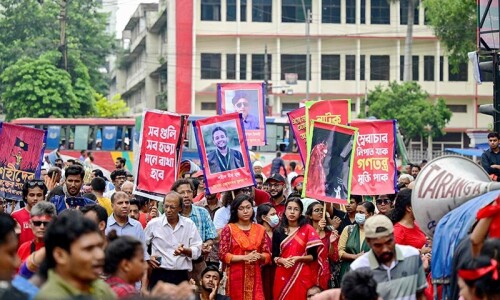
The ruling Awami League government has accused Jamaat and Shibir of violent attacks on government properties during the ongoing student-led protests demanding reform of government job quotas. The demonstration that began in mid-July resulted in over 200 deaths.
Huq labelled Jamaat as a “platform of militants”, noting that its top leaders were already tried for crimes committed during the 1971 war of independence.
“It was essential to ban JI and its student wing, Islami Chhatra Shibir,” Huq remarked.
This was the second time the party was banned in independent Bangladesh. The first ban was imposed in 1972 due to its “anti-liberation stance”, following a new constitutional provision that outlawed religion-based politics.
However, the ban was lifted three years later when Gen Ziaur Rahman, who came to power, amended the constitution through a martial law proclamation.
In response to the ban, Shafiqur Rahman, the head of Bangladesh JI, issued a statement vehemently condemning and protesting the executive order that prohibits his party’s political activities.
Rahman accused the government of “orchestrating violence through party supporters and law enforcement to stifle the student community’s non-political protests” and claimed the circular was issued “to divert attention from the real issues”.
Journalist and analyst Shayan S Khan believes that banning the JI and its student wing “will not” benefit the Awami League politically, especially given that the party’s popularity has diminished among the apolitical populace during the ongoing student-led protests.
“The only result of the Jamaat-Shibir ban is to appease the right-wing Bharatiya Janata Party (BJP) in New Delhi,” Khan said, noting New Delhi’s concerns about Islamist parties and its perceived support for the Hasina regime over the past decade.
Bangladesh Nationalist Party Secretary General Mirza Fakhrul Islam Alamgir had criticised the decision on Tuesday, saying it was poorly motivated and intended to shift public attention away from more pressing issues.
The student-led protest continues strongly, despite the Supreme Court order to scale back job quotas.