At least 43 killed as clashes rock Bangladesh, curfew imposed
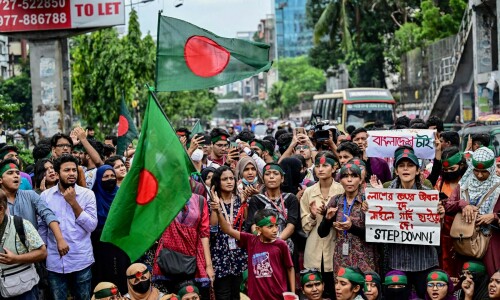
![[4/6] Objects set on fire burn as demonstartors with sticks occupy the street during a protest demanding the stepping down of Bangladeshi Prime Minister Sheikh Hasina, following quota reform protests by students, in Dhaka, Bangladesh, August 4, 2024.—Reuters](https://i.dawn.com/primary/2024/08/041957084894151.jpg "[4/6] Objects set on fire burn as demonstartors with sticks occupy the street during a protest demanding the stepping down of Bangladeshi Prime Minister Sheikh Hasina, following quota reform protests by students, in Dhaka, Bangladesh, August 4, 2024.—Reuters")

At least 43 people were killed and hundreds injured in clashes in Bangladesh on Sunday, as police fired tear gas and rubber bullets to disperse tens of thousands of protesters calling for Prime Minister Sheikh Hasina to resign.
The government declared an indefinite nationwide curfew starting at 6pm on Sunday, the first time it has taken such a step during the current protests that began last month.
It also announced a three-day general holiday starting from Monday.
The unrest, which has prompted the government to shut down internet services, is Hasina’s biggest test since January when deadly protests erupted after she won a fourth straight term in elections that were boycotted by the main opposition Bangladesh Nationalist Party.
Critics of Hasina, along with human rights groups, have accused her government of using excessive force to stamp out the movement, a charge she and her ministers deny.
Demonstrators blocked major highways on Sunday as student protesters launched a non-cooperation program to press for the government’s resignation, and violence spread nationwide.
“Those who are protesting on the streets right now are not students, but terrorists who are out to destabilise the nation,” Hasina said after a national security panel meeting, attended by the chiefs of the army, navy, air force, police and other agencies.
“I appeal to our countrymen to suppress these terrorists with a strong hand.”
Police stations and ruling party offices were targeted as violence rocked the country of 170 million people.
At least five people were killed and dozens injured amid fierce clashes in several places in the capital, Dhaka, police and witnesses said.
Two construction workers were killed on their way to work and 30 injured in the central district of Munsiganj, during a three-way clash of protesters, police and ruling party activists, witnesses said.
“They were brought dead to the hospital with bullet wounds,” said Abu Hena Mohammad Jamal, the superintendent of the district hospital.
Clashes
Police said they had not fired any bullets and said injuries were caused by improvised explosives that were detonated as the area turned into a battleground.
In the northeastern district of Pabna, at least three people were killed and 50 injured during a clash between protesters and activists of Hasina’s ruling Awami League, witnesses said.
Three people were killed in violence in the northern district of Bogura, and 30 were killed in 12 other districts, hospital officials said.
“An attack on a hospital is unacceptable,” said Health Minister Samanta Lal Sen after a group vandalised a medical college hospital and set fire to vehicles, including an ambulance, in Dhaka.
For the second time during the recent protests, the government shut down high-speed internet services, mobile operators said. Social media platforms Facebook and WhatsApp were not available, even via broadband connections.
Bangladesh authorities instructed the country’s telecoms on Sunday to shut down 4G, effectively disabling internet services, according to a confidential government memo seen by Reuters.
“You are requested to shut down all your 4G services until further notice, only 2G will be effective,” said the document issued by the National Telecommunication Monitoring Center, a government intelligence agency.
Telecoms companies were previously told their licenses would be cancelled if they did not comply with government orders, a person with direct knowledge told Reuters.
The telecom regulatory body did not respond to Reuters’ calls.
Last month, at least 150 people were killed and thousands injured in violence touched off by student groups protesting against quotas for government jobs.
The protests paused after the Supreme Court scrapped most quotas, but students returned to the streets in sporadic protests last week, demanding justice for the families of those killed.
“I think the genie is out of the bottle and Hasina may not put it back in the bottle again,” said Shakil Ahmed, associate professor for government and politics at Jahangirnagar University.
“The prime minister should immediately form a national government to facilitate greater unity.”