‘First printed copy of Holy Quran was found in 1987’


KARACHI: A European scholar and academic has said the first printed copy of the Holy Quran was published in Venice by Paganino and Alessandro Paganini in about 1537/1538.
“Nobody saw the copy until 1987, and even then, only one copy attested to its existence. That was discovered through people who could understand Arabic,” said Roberto Tottoli, a professor of Islamic Studies at the Università di Napoli L’Orientale in Italy, specialising in early Islamic traditions, literature, and the Quran’s role in European history.
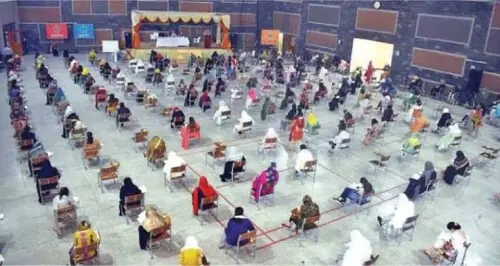
He was delivering a lecture on Monday, hosted by the Institute of Business Administration (IBA) titled “Printing Holy Texts: The Case of the Quran in Comparative Perspective”, focused on making the history and printing of the Holy Quran easier to understand.
Delving more into the history of the Holy Quran over the centuries, specifically related to its printing and translations, he educated the audience about the Chinese Buddhist books, which presented some of the largest and culturally significant examples of printed materials.
“These texts were previously believed to hold healing powers,” he informed.
Continuing the lecture, he discussed the early stages of translating the Arabic text of the Quran in Europe. He explained that despite a strong interest in publishing, many faced challenges in finding suitable fonts for printing during that era.
He then mentioned Hinckelmann, who was a head pastor at St. Catherine’s Church in Hamburg who translated and printed the Quran in Latin just before he died. After his death, Johann Andreas Danz announced that he was working on a translation of the Holy Book in collaboration with Hinckelmann, but he stopped at Surah Baqarah, Verse 66. At this point, Mr Tottoli stressed the importance of calligraphy and the specific way the Quran is translated and printed.
He then discussed J. Zechendorff’s attempt to immortalise two surahs by including a translation alongside the original Arabic text of the Quran. However, he noted that the quality of the characters (similar to alphabets in other languages) was poor, making it an unsuccessful effort.
He also guided the audience through L. Maracci’s version, who published a translation and explanation of the Holy Quran. However, he struggled to produce a high-quality copy, as much of his work was identified by the verse divisions in the Latin translation.
“It is very important to consider the fonts and other technicalities while printing holy texts,” he remarked.
He then talked about how Islamic countries gradually shifted from producing lithographic editions to printing with movable type. In 1877, Hafiz Osman printed the Mushaf, which became widely distributed across Islamic countries, surpassing both earlier and later printings.
After educating the audience sufficiently about the history associated with the printing and translations of the Quran, he briefly unfolded the concept of Kazan printings. In 1801-1802, copies were transferred to Kazan, where the Quran was published in numerous editions throughout the first half of the 19th century. This was also the very first issue of the Holy Book printed by the Muslims.
“The printings of Kazan played a fundamental role in the dissemination of a particular reading,” he said.
He mentioned that Saudi Arabia and other Gulf countries have been the most active contributors, consistently funding the production of printed Qurans and supporting the establishment of standardised text forms.
He then talked about recent developments in the printing industry, noting that Saudi Arabia and other Gulf countries have been the most active contributors.
Towards the concluding remarks, he mentioned that modern printing involves better fonts and other developments, such as colours and visible text, which were not prominent features in previous editions.
A question-and-answer session followed the lecture.
Published in Dawn, September 3rd, 2024