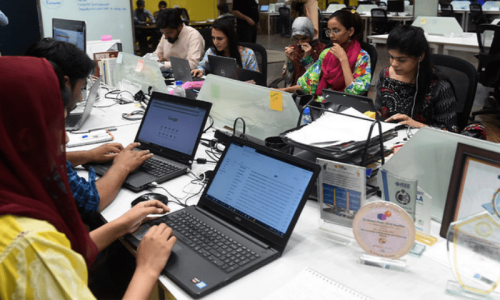
GENEVA: As Pakistan struggles to digitalise domestic trade and revenues, and entrepreneurs and consumers face online challenges, particularly in recent months, the leading multilateral institutions have called upon the governments, especially in developing and least developed countries, to invest in digital literacy, infrastructure and regulatory environment to reap maximum benefits from the largest and fastest growing international digital trade.
“Governments need to put in place a regulatory and policy environment that not only facilitates trade in a digital world but also generates inclusive and sustainable outcomes,” said a new report jointly prepared by the World Trade Organisation (WTO), International Monetary Fund (IMF), Organisation of Economic Cooperation and Development (OECD), United Nations Conference on Trade and Development (Unctad), and the World Bank.
The report, titled Digital Trade for Development and released on Friday, said that policies and regulations “should enable remote transactions, enhance trust in digital markets, promote affordable access and support cross-border deliveries”.
It added that a “predictable and interoperable environment that provides appropriate safeguards related to online transactions — such as data privacy, consumer protection and cybersecurity — is essential for the digital trade ecosystem to thrive”.
Say policies, regulations should enable remote transactions, promote affordable access
The authors advised that laws and regulations that ensure easy entry and exit of firms, effective competition and an open trade regime promote healthy competition. Estimates suggest that improved digital connectivity was twice as effective at lowering trade costs in middle- and low-income economies with an enabling regulatory environment for digitally delivered services.
The report found that cross-border digitally delivered services were the fastest-growing segment of international trade, with new players emerging. Digital trade refers to all international trade digitally ordered and/or digitally delivered.
According to WTO estimates, digitally delivered services have recorded an almost fourfold increase in value since 2005, rising 8.1pc on average per year over the period 2005-22, outpacing 5.6pc in goods and 4.2pc in other services exports to account for 54 per cent of total services exports. With new ways of obtaining comparative advantage, opportunities arise for new players to engage in global markets, including for farmers to connect to markets and for small businesses to trade via parcels.
The experts noted that while developed economies were responsible for the majority of digitally delivered services exports, they had also grown in most developing economies. That said, growth in least-developed countries (LDCs) continues to lag. During the Covid-19 pandemic, the gap between the most and the least advanced economies in terms of exports of such services widened further.
The research found that some economies were more prepared to seize opportunities and take on challenges associated with digital trade, highlighting the importance of digital skills. “In general, to engage in and benefit from digital trade, consumers and businesses must have access to fast, affordable and reliable digital infrastructure as well as the skills and capabilities to use digital technologies for productive activities,” it observed.
The report also noted that an estimated 5.4 billion people, or 67pc of the world’s population, were able to connect to the internet at present, doubling the number of people connected only 10 years ago. Yet, 2.6bn people, or one-third of the global population, remain offline, most of them in low- and lower-middle-income economies.
High tariffs on imports of information and communication technology (ICT) equipment, restrictions on imports of enabling services and limited competition in telecommunications services can reduce affordability and slow down the adoption of these technologies.
The group of multilaterals advised for a comprehensive and multi-faceted strategy to improve the adoption and effective use of digital technologies. This strategy should include “investments in physical and digital infrastructure, enhancing digital literacy and skills, and adopting regulatory frameworks that are conducive for digital trade”, it said, adding that efforts to bridge socioeconomic and cultural divides were also crucial.
Bridging the digital divide and strengthening the readiness of developing economies to benefit from digital trade requires both domestic and international mobilisation, the multilateral development partners said. In this respect, they called for more international financial and technical support to build the capacity of developing economies to improve connectivity and skills and to regulate in areas relevant to digital trade.
Published in Dawn, September 14th, 2024