ISLAMABAD: The Supreme Court asserted its authority on Monday, explaining that in the exercise of constitutional power to dispense complete justice, it was not handicapped by any technicality or dependent on any rule of procedure.
A 70-page detailed reason issued here on Monday explained why eight judges constituting the majority of the 13-judge Supreme Court decided in favour of the Pakistan Tehreek-i-Insaf (PTI) to settle the thorny issue of reserved seats.
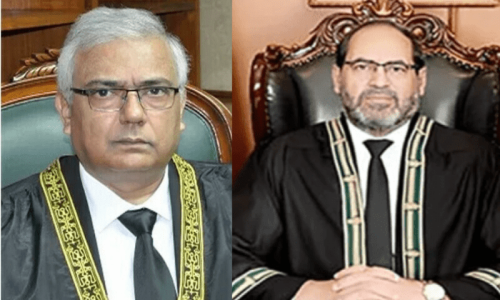
Authored by senior puisne judge Justice Syed Mansoor Ali Shah, the judgement categorised into multiple sub-headings emphasised that the PTI was before the bench with an application for impleadment as a party in the case.
“The procedural formality of first accepting PTI’s application and then granting it the relief does not carry much weight where the apex court’s concern is the protection of the right of vote of the electorate guaranteed under Articles 17(2) and 19 of the Constitution, more than the right of any political party — whether it be Sunni Ittehad Council (SIC) or PTI or any other party,” the judgement contended.
Where the rights of people are involved the proper place of procedure in any system of administration of justice is to help and not thwart the grant to the people of their rights, Justice Shah emphasised. He said the case in hand regarding the reserved seats was not an ordinary civil case but a case of the highest order where democracy — a salient feature of the Constitution — and the fundamental right of the people to choose their representatives for the legislative and executive organs of the state was to be protected.
The detailed reasons explained that the constitutional power of the Supreme Court under Article 187(1) was to do complete justice when there was no specific provision of law that covered the matter.
The judgement also had some flak reserved for the Election Commission of Pakistan (ECP) when it said the body failed to fulfil its constitutional role in the Feb 8 elections.
Being the ‘constitutional electoral management body’, the commission is not merely an administrative entity but a fundamental “guarantor institution” of democratic processes, with a constitutional status akin to a “fourth branch of government”.
ECP receives flak
It said the ECP was tasked with ensuring the transparency and fairness of elections to maintain public trust in the electoral system, but it, unfortunately, participated as the primary contesting party against the SIC and the PTI.
This function of organising the elections, as held by the Supreme Court in the 2022 Aam Log Itehad case, was primarily executive and not judicial or quasi-judicial, though the commission also performed some quasi-judicial functions, it said.
The function performed in the present case was quasi-judicial, the judgement explained. A body performing its quasi-judicial function in a matter between two rivals cannot be treated as an aggrieved person if its decision is set aside or modified by a higher forum or by a court of competent jurisdiction, Justice Shah observed.
Such a body, therefore, does not have locus standi to challenge the decision of higher forum or court. Nor can such a body contest an appeal filed against its quasi-judicial decision by one of the rival parties as a primary contesting party.
In the present case, the commission was a proper party to assist the court in settling all the questions involved in the case, it said, adding that the ECP should not have acted as a primary contesting party. The verdict said the PTI, its candidates and the electorate should not be made to suffer or be prejudiced by the unlawful acts or omissions of public functionaries, namely the returning officers (ROs) and the ECP.
Given that members have been deprived of their constitutional right to proportional representation in the reserved seats due to unlawful acts and omissions, the members are entitled, by virtue of an obligation to be restored to that right and placed, insofar as possible, in the same position they would have been if such unlawful acts and omissions had not occurred.
The judgement also explained that the Sept 14 clarification order in which eight judges had rebuked ECP for not implementing its July 12 judgement in the reserved seats case should also be read as part of this judgement.
Referring to the March 14 Peshawar High Court (PHC) denial of reserved women and minority seats to SIC, the Supreme Court held that the ambit and scope of the high court under Article 199 was not as wide as of the Supreme Court under Article 187 of the Constitution.
Nor do the high courts possess general constitutional power which ECP has under Article 218(3) to ensure that elections are conducted honestly, justly and fairly, the judgement said.
Therefore, without PTI’s petition, the high court could not have passed an order like the one we have, or the one that the commission could have passed, for doing complete justice and ensuring that the election was conducted honestly, justly and fairly.
However, what PHC could have done, but failed to do, in the present case is to remand the matter to ECP with a direction to do what the commission was required to do under Article 218(3) of the Constitution, read with Section 4 and 8 of the Elections Act, the judgement said.
“We are completely at a loss to understand the logic, other than the constraint of the circumstances, as to why a candidate of a national-level political party (PTI), which had once formed the federal and two provincial governments, would supersede his candidature of that party (PTI) with a party (PTI-Nazriati) whose name had not even been heard by most of the electorate, or why he would leave the candidature of PTI and become an independent candidate, by his own free will,” the judgement said.
In his separate note, Justice Yahya Afridi said the ECP should revisit its notification of returned candidates, keeping in view that a returned candidate, who declared himself to represent a political party and submitted the certificate of that political party and hasn’t withdrawn the declaration, has to be declared a returned candidate representing the said political party and not otherwise. The needful be done within seven days if not earlier, Justice Afridi said.
Published in Dawn, September 24th, 2024