THE news from New York is not good. On Sunday, as world leaders arrived for the 79th session of the UN General Assembly that was set to begin on Tuesday, UN Secretary General António Guterres inaugurated the Summit for the Future.
The Summit for the Future is supposed to be a quasi-climate summit that is meant to jump-start the stalled progress over climate change. It took only a day, however, for world leaders to begin to warn that the distance between the countries was growing. As the UN chief put it, “crises are interacting and feeding off each other — for example, as digital technologies spread climate disinformation, that deepens distrust and fuels polarisation”.
It is true that the urgency of climate change is impressing itself on some countries far more than on others. Take, for instance, the case of Jakarta in Indonesia, which is perhaps the fastest sinking city in the world. In 2022, when world leaders gathered at the climate summit in Egypt, António Guterres had a message for them: “It is either a Climate Solidarity Pact — or a Collective Suicide Pact.”
The case of Jakarta is particularly pertinent here as an example of how climate change is already causing enormous change in the lives of people living in the Global South.
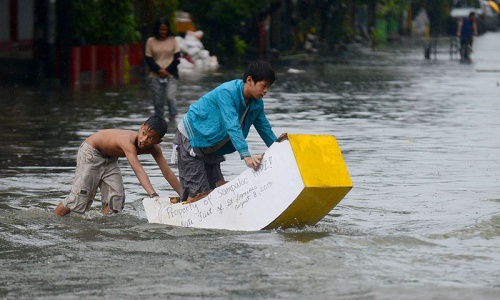
Jakarta suffers from a tragic confluence of environmental and climate-related issues. Rising sea levels, poor air quality, and huge amounts of rainfall have all coalesced to cause a situation where large parts of the city are likely to be under water by 2050. It is perhaps this urgency and the lack of any chances of real progress resulting from the multilateral COP summits over the years that has led Jakarta to find its own solutions.
Instead of letting the fortunes of a city rely on help or international cooperation that may not come, the Indonesians have decided to move the Indonesian capital away from the island of Java, where Jakarta is located, to the island of Borneo in East Kalimantan province. The new capital of Indonesia will be Nusantara and this year marked the first time when independence day celebrations were held there.
The urgency of climate change is impressing itself on some countries far more than on others.
The fact that Jakarta is suffering not just from the effects of climate change but also a mix of environmental and climate-related factors should be instructive for places like Pakistan.
In Jakarta, there has been unrestrained extraction of underground water through wells. Heavy rainfall could have replenished these wells but the urban sprawl prevents this. Flooding in the city is exacerbated by the fact that Jakarta, being on lower ground, also gets water run-off from higher terrains.
Finally, the rising seas are the third body of water that are causing the city to sink. It is estimated that at least half of the city is already below sea level. Moving the capital city to a planned settlement will mean moving to a new urban hub but it will not mitigate the truth that Jakarta as a city is still sinking and is likely to cause the loss of livelihoods and resources for millions of homes in the megacity.
While Jakarta has a different climate than Karachi’s, some of the factors that have affected that city threaten Karachi as well. In recent years, Karachi has also reeled from heavy flooding after unexpected torrential rains. Like many other megacities, the city’s urban sprawl led to an increase in flooding following torrential rainfalls.
Not only that, Karachi also experiences the urban heat island effect. The urban heat island effect occurs when the concrete and asphalt surfaces of the city cause temperatures within these built-up environments without natural vegetation to have a temperature that is higher than that in the adjoining areas, which have green cover. Several investigative reports focused on Karachi have shown that the city regularly suffers from the urban heat island effect, especially during the summer months.
Even more problematic is the fact that the most built-up areas with the least amount of vegetation are often also the poorest ones. The poorest areas in turn are the ones least likely to be able to afford electricity or to have other means of cooling their environs. The people who live here are most vulnerable to heat strokes and other heat-related illnesses as ‘staying cool’ increasingly becomes a luxury for the majority of the city’s denizens.
In Jakarta’s case, the problems were not always so intractable but the inability to arrive at solutions owing to corruption and lack of political will created a situation where moving the capital was the band-aid that was passed off as a solution. Similarly, Karachi’s issues can be solved if there is proper zoning and a commitment to adopt policies that somehow address the issues faced by the city. However, this is unlikely to come about, given the rampant greed, corruption and the lack of motivation and political will that prevail.
In the meantime, it is hard to put any stock in expensive multilateral convenings such as the Summit for the Future whose goal is to get member nations to agree to a Pact for the Future. The only value in it seems to be a free trip for the delegates picked from whichever ruling party seems to be having its turn in power to enjoy cooler weather in a northern capital. This time, too, the conflagration in the Middle East, which is worsening by the moment as larger parts of the region get sucked into the conflict, will overtake whatever attention may have been allotted to climate change.
As has been the case in such discussions in the past, the gulf between the experts in the Western countries who make climate policy and the people in the Global South who face the actual heat and the deluge seems too wide to bridge.
The writer is an attorney teaching constitutional law and political philosophy.
Published in Dawn, September 25th, 2024